

Cut Costs with Smarter AI Lead-Time Insights in Oracle Supply Chain


Planning is only as good as the assumptions behind it. For decades, businesses have relied on static supplier lead times – numbers set once in the system, rarely updated, and often far from reality. The result? Either excess stock gathering dust in warehouses or constant firefighting with expedite orders when things do not arrive on time. Both are expensive.
AI supply chain cost reduction lead time analytics change that story entirely – replacing static assumptions with dynamic, data-driven intelligence that tells planners exactly where time is being lost and where costs can be recovered.
Why Lead Time Variability Is Costing Your Business
Static lead times are a planning fiction. The number in the system represents what a supplier promised – not what they consistently deliver. When actual performance diverges from that assumption, the business absorbs the gap in one of two ways:
- Excess safety stock – buffers inflated to cover uncertain lead times lock working capital in inventory that may never be needed, while increasing carrying costs across every SKU
- Emergency expediting – when inflated buffers still fail to cover actual delays, last-minute expedite orders trigger premium freight charges, supplier rush fees, and production disruption costs
How AI reduces procurement and lead time costs starts with making the invisible visible – surfacing what suppliers are actually delivering versus what the system assumes, and giving planners the intelligence to act before costs accumulate.
How AI Delivers Smarter Lead Time Analytics
Oracle Fusion Cloud Lead-Time Insights AI gives planners an intelligent companion that sees beyond static assumptions – listening to actual delivery data and surfacing the truth about where time is being lost and where it can be recovered.
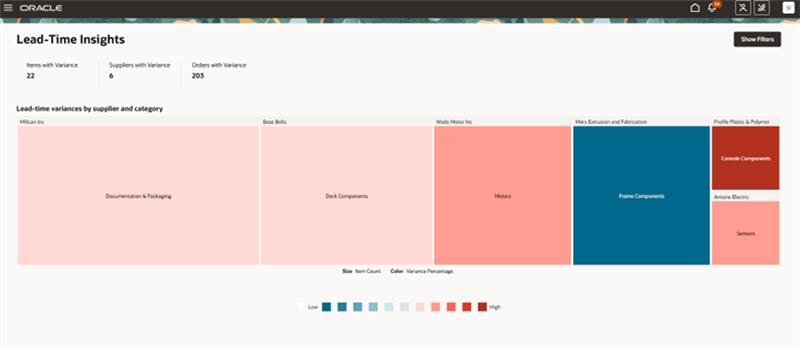
Instead of drowning in spreadsheets, planners are greeted by a Treemap Overview – a visual landscape where each supplier and item is represented as a block. The bigger the block, the bigger the impact. The warmer the color, the greater the variance.
It is more than data. It is a landscape of time itself – showing planners not just where problems exist but where opportunities lie.
AI-driven lead time analytics for cost savings surfaces three types of actionable intelligence simultaneously:
- Consistent over-delivery – suppliers regularly delivering faster than the system assumes, creating an opportunity to safely reduce safety stock without service risk
- Consistent under-delivery – suppliers regularly delivering slower than assumed, flagging proactive procurement intervention before delays cascade into production disruptions
- High-variance suppliers – suppliers with unpredictable delivery patterns, identifying where buffer stock investment is genuinely justified versus where it is simply offsetting bad data
Oracle SCM AI: Cost Reduction Built Into Supply Planning
Oracle SCM AI for cost reduction and lead time optimization is embedded natively within Oracle SCM Cloud – meaning lead time intelligence operates within the same planning environment your team already uses, not a separate analytics platform requiring data exports and manual interpretation.
Key Oracle SCM Cloud AI capabilities for lead time cost reduction include:
- Dynamic lead time adjustment – AI continuously recalibrates lead time assumptions based on actual supplier delivery data, keeping planning parameters aligned to reality rather than historical assumptions
- Replenishment timing optimization – AI recommends optimal order timing based on supplier-specific performance patterns, reducing both early ordering waste and late ordering expediting costs
- Safety stock right-sizing – AI surfaces where safety stock levels are higher than actual supplier variance justifies, identifying working capital release opportunities across the item master
- Supplier performance scoring – planners see an objective, AI-generated reliability score for every supplier – giving procurement teams an evidence base for supplier development conversations and sourcing decisions
- Cost exposure alerting – AI flags emerging lead time variances before they generate expediting costs, giving planners the window to act proactively rather than reactively
For organizations asking how Oracle SCM Cloud supports lead time cost reduction, these capabilities activate within the existing Oracle environment – no new platform, no separate implementation.
From Data to Dollars: Quantifying AI Lead Time Cost Savings
The financial impact of cutting supply chain costs with AI lead time insights Oracle operates across multiple cost categories simultaneously:
- Inventory carrying cost reduction – every day of safety stock removed through AI-informed right-sizing reduces storage, insurance, obsolescence, and capital cost across the affected SKUs
- Expediting cost elimination – proactive identification of at-risk suppliers removes the need for emergency freight and rush supplier fees that erode margin across high-variance categories
- Working capital release – reduced safety stock across the supply base frees working capital that can be redeployed into growth investments rather than sitting in warehouse inventory
- Supplier penalty avoidance – early identification of delivery risk allows procurement to intervene or source alternatives before contractual service level penalties are triggered
- Markdown and obsolescence reduction – for seasonal and short-lifecycle products, accurate lead time intelligence prevents the overstock situations that generate clearance markdowns and write-offs
Most enterprises see measurable cost reductions within 3–6 months of implementing AI-powered lead time analytics, with full ROI typically achieved within 12–18 months.
Case for AI: Before and After Lead Time Optimization
Industry Verticals Where Cost Savings Are Greatest
Retail and Consumer Goods Fashion trends fade quickly and seasonal products carry a short shelf life. With Lead-Time Insights, retailers avoid overstocking fast-moving items by aligning lead times with actual supplier performance – fewer markdowns, less clearance stock, and healthier margins while ensuring stores are stocked at the right time.
Automotive Automotive supply chains are famously complex, with tier-2 and tier-3 suppliers feeding critical parts into the production line. A missed delivery can stop production entirely. AI-driven lead time accuracy allows manufacturers to hold less buffer stock while still ensuring continuity – reducing inventory costs across thousands of parts without jeopardizing production schedules.
High-Tech Electronics Semiconductors and high-value electronic components carry high holding costs. Traditionally, companies maintained weeks of safety stock to offset uncertain lead times. Oracle Lead-Time Insights identifies which suppliers consistently meet or beat commitments – allowing planners to reduce buffer stock and free working capital in a cash-intensive sector where every dollar tied up in inventory has a measurable opportunity cost.
Mini Case: Electronics Manufacturer Unlocks Hidden Savings
A leading consumer electronics company producing smartphones faced ballooning inventory costs. The system assumed a 20-day lead time for semiconductor suppliers – but AI analysis revealed three key suppliers consistently delivered in 14–15 days.
Armed with this insight, planners safely reduced safety stock across multiple product lines – cutting inventory by 15%. The financial impact was significant: millions of dollars in freed working capital, without compromising product availability during peak launch season.
What once looked like a necessary cost of doing business became an efficiency opportunity – unlocked entirely by Oracle Lead-Time Insights AI surfacing data that had always existed but had never been acted on.
Rapidflow’s Oracle SCM Cost Reduction AI Expertise
Rapidflow conducts supply chain diagnostics, identifies lead time cost drivers, and configures Oracle SCM AI tools to target the highest-impact areas for cost reduction – across procurement, inventory planning, and supplier performance management.
Our Oracle SCM cost reduction implementation approach covers:
- Supply chain diagnostic – mapping current lead time assumptions against actual delivery performance to quantify the cost gap AI will address
- Oracle SCM Cloud Lead-Time Insights AI activation and Treemap configuration aligned to your supplier and item hierarchy
- Safety stock right-sizing model setup – defining AI-informed buffer levels by supplier reliability tier
- Supplier performance scoring configuration and threshold alerting setup
- Replenishment timing optimization aligned to your procurement policies and inventory targets
- Integration with Oracle Procurement Cloud and Oracle Inventory for end-to-end cost visibility
- Planner enablement – training supply planning teams to act on AI lead time intelligence in daily workflow
- Cost reduction performance tracking – carrying cost, expediting spend, and working capital metrics measured against pre-AI baseline
How does AI in supply chain reduce lead time costs?
+
AI identifies variability drivers, flags at-risk suppliers early, and recommends optimal order timing – reducing expediting costs, excess inventory, and stockout penalties.
What cost categories does AI lead time optimization impact?
+
AI lead time analytics reduce carrying costs, expediting fees, emergency freight charges, stockout losses, and supplier penalty costs.
How does Oracle SCM Cloud support lead time cost reduction?
+
Oracle SCM Cloud uses AI and ML to dynamically adjust lead time buffers, recommend replenishment timing, and surface cost-reduction opportunities across the supply chain.
What is a realistic ROI timeline for AI lead time analytics?
+
Most enterprises see measurable cost reductions within 3–6 months of implementing AI-powered lead time analytics, with full ROI typically achieved within 12–18 months.
Can AI lead time optimization help with global supply chains?
+
Yes. AI is especially valuable for global supply chains where multi-tier supplier variability, customs lead times, and freight cost fluctuations create significant cost exposure.
How does Rapidflow approach Oracle SCM cost reduction projects?
+
Rapidflow conducts a supply chain diagnostic, identifies lead time cost drivers, and configures Oracle SCM AI tools to target the highest-impact areas for cost reduction.