

Boosting Supply Chain Productivity with AI-Powered Lead-Time Insights


In supply planning, productivity does not just mean working harder – it means working smarter. Yet planners often find themselves buried in spreadsheets, reconciling supplier promises while hours are lost figuring out why orders are late, which suppliers can be trusted, and where to focus first.
The result? Slow decisions, missed opportunities, and planners left exhausted.
Oracle SCM Cloud AI is changing that with AI-powered lead-time insights – turning the invisible into visible, and the messy into manageable. For enterprises asking how AI improves lead time insights in supply chain, the answer starts with giving every planner precision, clarity, and real-time intelligence at their fingertips.
What Are Lead-Time Insights and Why AI Changes Everything
AI lead time optimization supply chain goes far beyond tracking whether a shipment is late. Traditional supply planning relies on static lead times – fixed numbers that rarely reflect real supplier behavior. AI replaces that with dynamic, data-driven intelligence.
AI lead-time insights use machine learning to analyze historical supplier data, detect patterns, and predict future delivery timelines – helping planners proactively manage disruptions before they impact production schedules. The shift is fundamental: from reacting to delays after they happen, to anticipating and preventing them before they occur.
For procurement teams managing hundreds of suppliers across global networks, AI lead time insights for procurement teams means fewer surprises, faster decisions, and a supply chain that runs on facts rather than assumptions.
How AI Predicts and Optimizes Supplier Lead Times
AI-powered lead time prediction Oracle SCM works through two core capabilities that together give planners complete visibility:
The Supplier Variance Table – Precision at Scale
The first step is clarity. With the Supplier Variance Table, the fog lifts:
- Average days late per supplier
- Variance percentages across order history
- Historical performance trends over configurable time periods
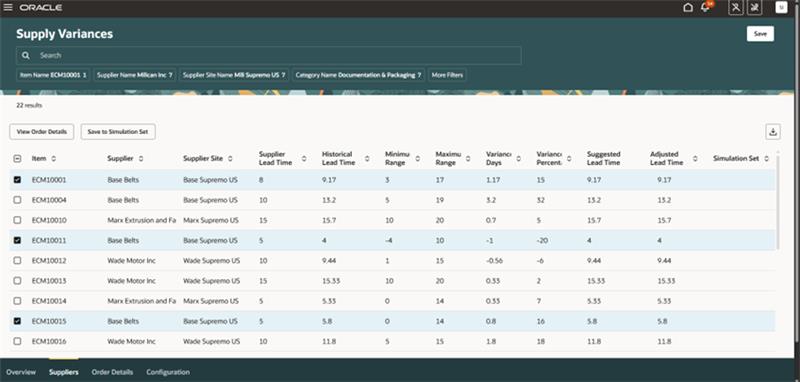
Cold, hard numbers reveal who is delivering as promised and who is quietly drifting off course – with no hiding behind vague excuses or anecdotes. This precision allows planners to prioritize with confidence: focus on the few suppliers causing the most disruption instead of spreading energy thin.
The Order Details View – Every Order, Every Detail
Boosting supply chain productivity with AI lead time analytics also means finding the fine cracks before they spread. With the Order Details View, each shipment becomes a case file:
- Ordered quantity and date
- Received quantity and date
- Variance marked and flagged automatically
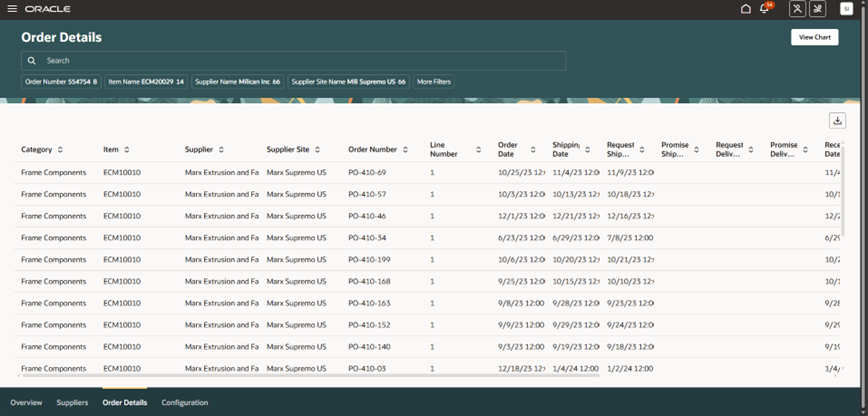
Delays stop being abstract trends and become individual stories of movement and misstep. This order-by-order transparency uncovers the hidden causes of variance – a bottleneck at customs, a carrier delay, or a supplier batching orders inefficiently. Planners are not firefighting. They are problem-solving.
Oracle SCM AI: Lead-Time Intelligence Built In
Key capabilities built into Oracle SCM AI include:
- Dynamic lead-time recalculation – AI continuously updates lead time estimates based on the latest supplier performance data
- Anomaly detection – outlier shipments are automatically flagged for planner review before they cascade into production delays
- Supplier risk scoring – AI scores suppliers by reliability, giving procurement teams an objective basis for sourcing decisions
- Real-time alerting – planners receive proactive notifications when lead time variance exceeds defined thresholds
- Integration with demand planning – lead time intelligence feeds directly into supply planning workflows, aligning procurement with actual demand signals
For organizations evaluating Oracle AI for supplier lead time management, these capabilities operate within the existing Oracle Cloud environment – activated through configuration, not a new implementation.
From Reactive to Proactive: AI-Driven Supply Planning
The productivity lift from AI lead time optimization supply chain comes in multiple dimensions:
Industrial Manufacturing
In industries where downtime costs millions per hour, productivity depends on proactive planning. Supplier Variance Tables highlight which parts of the network are unreliable, letting planners focus energy where it matters most preventing costly downtime.
- Faster decisions – prioritize the top variance drivers instantly without manual data gathering
- Smarter supplier meetings – walk into performance reviews with facts, not guesswork
- Focused interventions – fix root causes instead of patching symptoms quarter after quarter
- Reduced planning errors – organizations using AI lead-time analytics typically see 15–30% reduction in planning errors and significant improvements in on-time delivery rates
AI-powered lead time prediction enterprise transforms supply planning from a reactive discipline into a genuinely proactive one – where disruptions are anticipated, not discovered.
Measuring Productivity Gains with AI Lead-Time Analytics
Pharmaceuticals Drug supply chains are regulated and time-sensitive. AI lead time insights allow planners to spot recurring supplier delays at the batch level – enabling faster corrective actions and ensuring products reach patients without delay.
Industrial Manufacturing Where downtime costs millions per hour, productivity depends on proactive planning. Supplier Variance Tables highlight which parts of the network are unreliable, letting planners focus energy where it matters most.
Consumer Packaged Goods (CPG) Fast-moving products leave little margin for inefficiency. By investigating shipment-level details, planners identify chronic bottlenecks – such as repeated carrier delays – address them, and keep the supply chain flowing smoothly.
Mini Case: Pharma Company Doubles Planner Efficiency
A mid-sized pharmaceutical manufacturer struggled with recurring supplier delays, often uncovered only when production schedules had already slipped. Planners spent hours chasing shipment details across emails and spreadsheets.
After deploying Oracle Lead-Time Insights AI, the team relied on the Supplier Variance Table and Order Details View to pinpoint the worst offenders. In just one quarter:
- Planner investigation time dropped significantly
- Supplier performance review meetings became data-driven, cutting preparation time in half
- Corrective actions were logged and tracked order-by-order, reducing repeat delays
With AI lead time optimization supply chain, productivity is no longer about adding more hands on deck. It is about giving every planner the power of visibility, precision, and clarity – so the entire supply chain works faster, smoother, and sharper.
Rapidflow’s Approach to Oracle SCM AI Implementation
Rapidflow is an Oracle Partner with deep expertise in Oracle SCM Cloud AI features including lead-time optimization and supply chain analytics. Our implementation approach covers:
- Oracle SCM Cloud environment assessment and AI lead-time feature readiness review
- Supplier Variance Table and Order Details View configuration aligned to your supplier network
- AI threshold and alerting rules setup based on your planning policies
- Integration with demand planning and procurement workflows within Oracle Cloud
- User acceptance testing across supplier categories and lead-time scenarios
- Supply planning team enablement for AI-assisted supplier performance management
What is AI lead-time insight in supply chain management?
+
AI lead-time insights use machine learning to analyze historical supplier data, detect patterns, and predict future delivery timelines – helping planners proactively manage disruptions.
How does AI improve supply chain productivity through lead-time analysis?
+
reduces manual data gathering, surfaces real-time anomalies, and recommends corrective actions – allowing planners to make faster, more accurate procurement decisions.
Can Oracle SCM Cloud provide AI-powered lead-time insights?
+
Yes. Oracle SCM Cloud uses embedded AI and ML to provide dynamic lead-time recommendations and alert planners to supplier risk in real time.
What industries benefit most from AI lead-time optimization?
+
Manufacturing, retail, pharma, and high-tech industries with complex supplier networks see the greatest ROI from AI lead-time intelligence.
How much can AI reduce supply chain lead times?
+
Organizations using AI lead-time analytics typically see 15–30% reduction in planning errors and significant improvements in on-time delivery rates.
Does Rapidflow offer Oracle SCM AI implementation services?
+
Yes. Rapidflow is an Oracle Partner with deep expertise in Oracle SCM Cloud AI features including lead-time optimization and supply chain analytics.