



Stop Phishing at the Source: AI-Powered Enterprise Email Protection


You are wrapping up a long day. An email hits your inbox: “Urgent: Payment Confirmation Needed.” Familiar sender, professional formatting, just the right sense of urgency. You forward it to finance.
But this time, it was not just another task. It was the beginning of a phishing attack. One click. One forward. And now your business faces a chain reaction – data breach, financial exposure, compliance risk, and reputational harm.
This is not a technology failure. It is a human one. And it is exactly what AI enterprise email security phishing protection is built to prevent.
Why Phishing Remains the #1 Enterprise Cyber Threat
Human error is inevitable – especially under fatigue, pressure, or distraction. Even the most diligent employees can misjudge a situation. And that is precisely what attackers exploit.
Modern phishing emails are no longer easy to spot. Attackers have moved beyond poorly worded scam messages to highly personalized, psychologically crafted communications – tailored to the recipient, the organization, and the moment. Spear-phishing and Business Email Compromise (BEC) attacks routinely bypass firewalls, spam filters, and employee training because they are designed to look completely legitimate.
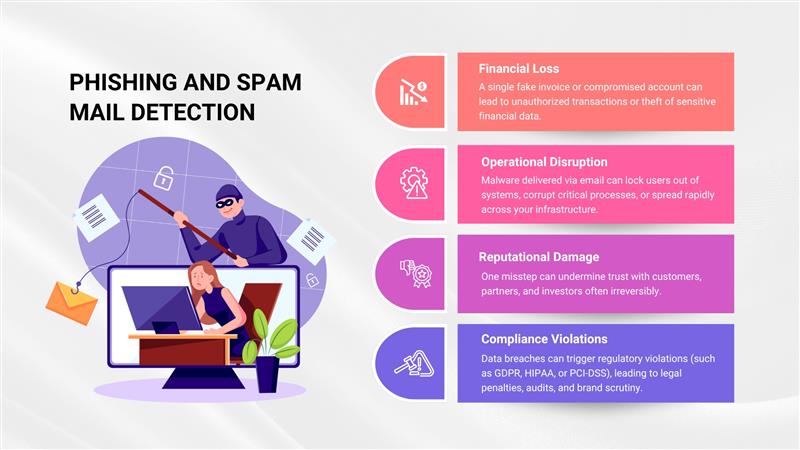
The consequences of a single mistake:
- Financial loss – fraudulent transfers, ransomware payments, and recovery costs
- Data breach – customer, employee, and partner data exposed
- Compliance exposure – GDPR, HIPAA, and SOX violations triggered by unauthorized data access
- Reputational damage – customer and partner trust eroded, often permanently
The cost of a single phishing incident can range from thousands to millions depending on the scale and sensitivity of the exposure – and the damage is rarely detected until it is already done.
How AI Detects and Blocks Phishing Emails in Real Time
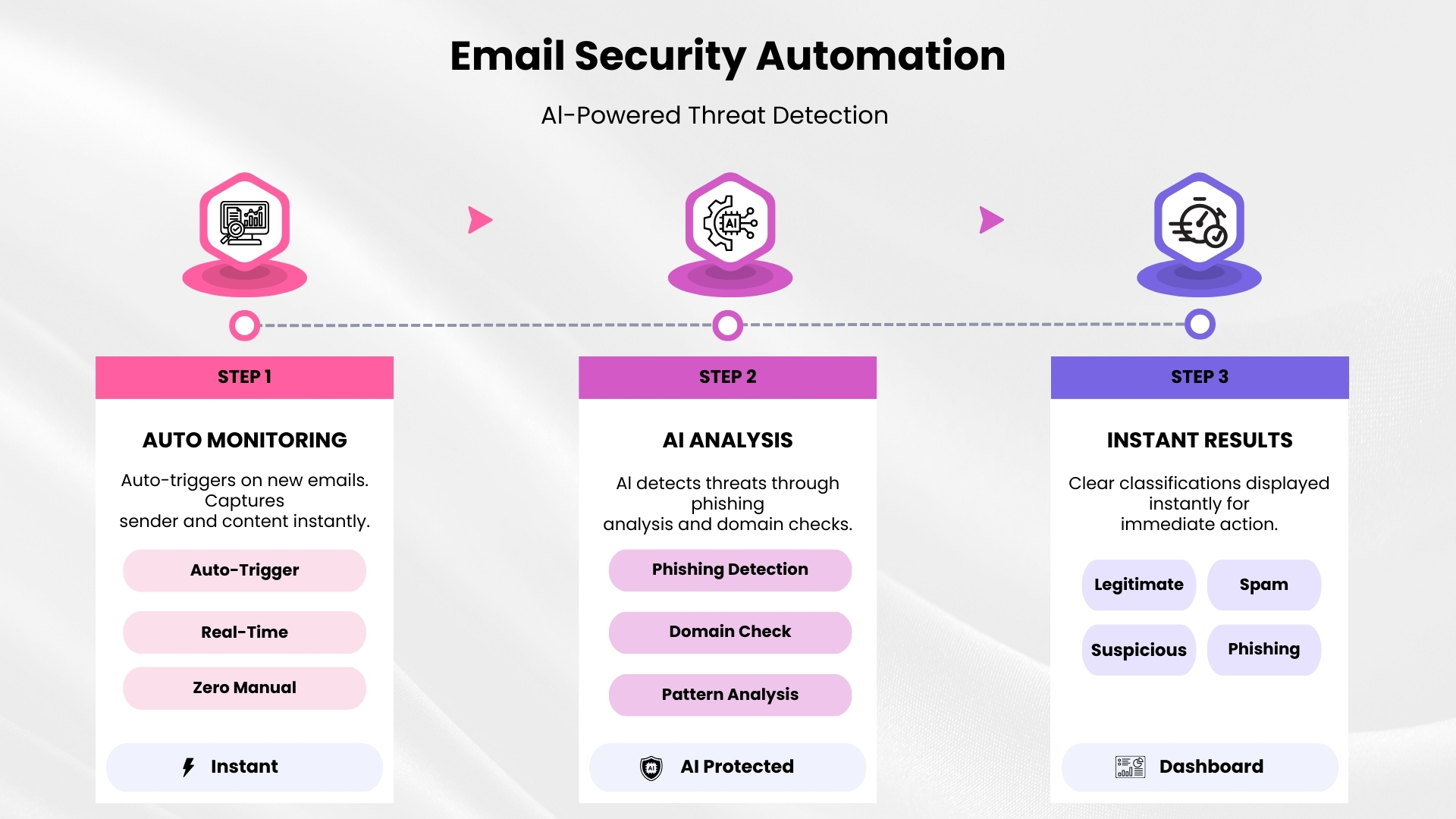
How AI stops phishing attacks at the source works across multiple simultaneous analysis layers – not a single filter:
- Email header and metadata analysis – sender reputation, domain age, routing anomalies, and spoofing indicators assessed before the message reaches the inbox
- Content and language pattern analysis – AI models identify urgency manipulation, impersonation language, and social engineering patterns invisible to rule-based filters
- URL and attachment risk scoring – embedded links and attachments are analyzed for malicious indicators, redirects, and known threat signatures in real time
- Behavioural baseline comparison – AI compares the email against the sender’s established communication patterns, flagging deviations that suggest account compromise or impersonation
- Contextual risk classification – each email is scored and classified – clean, suspicious, or malicious – with automated action triggered based on your organization’s defined security policy
The result: AI phishing detection and prevention that catches what human judgment misses, consistently, at enterprise email volume.
Machine Learning Models Behind Email Threat Intelligence
What separates AI phishing protection from traditional email filters is continuous learning. Static rule-based filters work against known threats. Machine learning for enterprise email security Oracle models learn from new attack patterns as they emerge – including zero-day phishing campaigns that have never been seen before.
Key ML capabilities in enterprise email threat detection:
- Supervised classification models – trained on millions of confirmed phishing and clean emails to score new messages with high accuracy
- Anomaly detection – unsupervised models identify unusual patterns in sender behavior, communication frequency, and content structure without requiring a known threat signature
- Natural language processing (NLP) – detects social engineering language, urgency manipulation, and impersonation tactics in email body content
- Continuous retraining – models update as new threat data is ingested, ensuring protection improves over time rather than degrading against evolving attacks
The outcome: AI models that reduce false positives, catch sophisticated BEC and spear-phishing attacks, and improve with every email processed.
Enterprise Email Security Integration
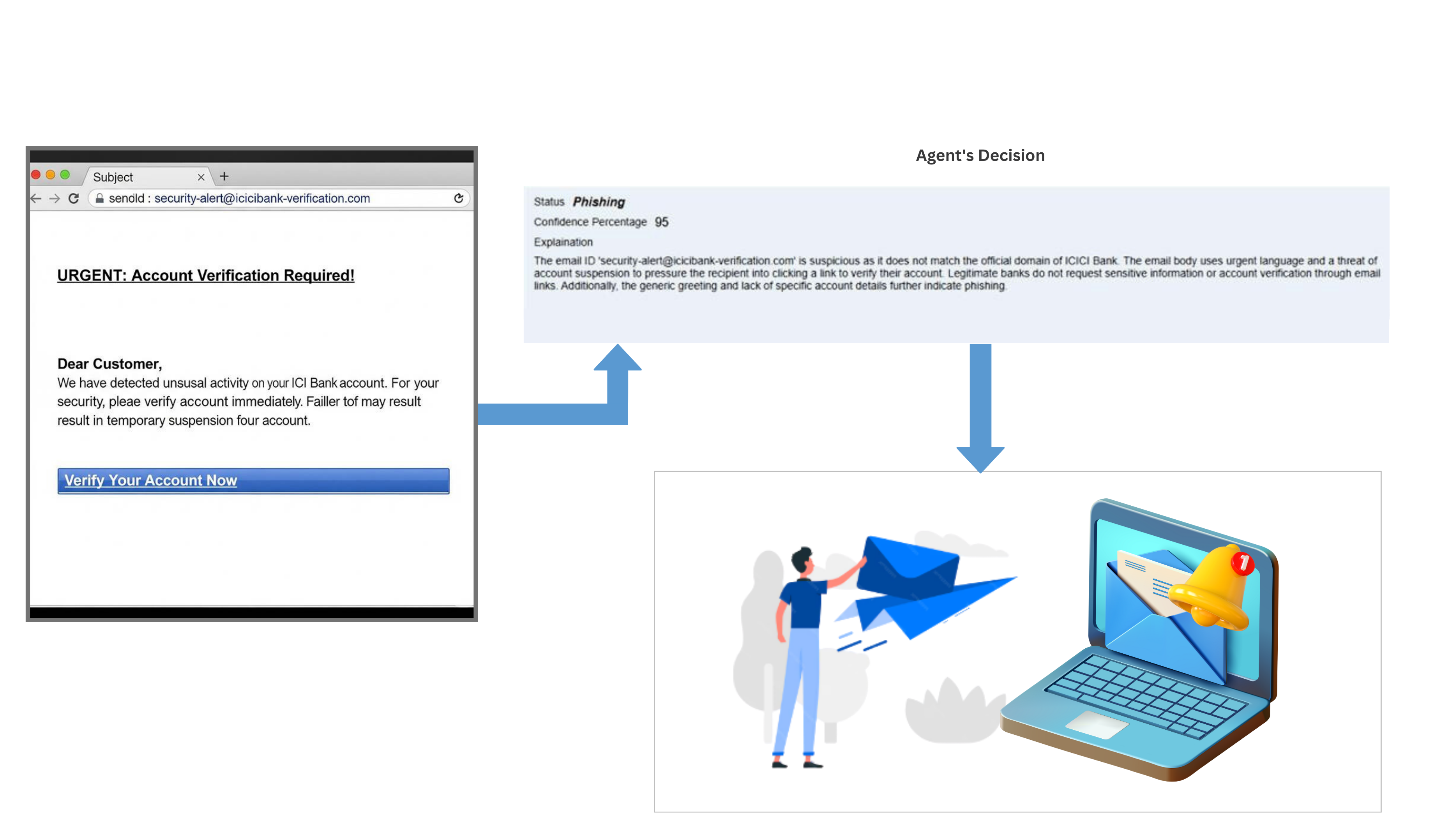
UiPath agentic automation capabilities for email security include:
-
- UiPath AI agents that monitor incoming email traffic, classify threat level, and trigger automated response workflows in real time
- UiPath Action Center escalation – flagged emails routed to the IT security team with full context and risk classification attached
- Automated quarantine and user notification workflows configured to your internal security policy thresholds
- End-to-end audit trail across every AI classification decision and automated action taken
For organizations on either platform – or both – AI-powered enterprise email phishing detection and prevention extends your existing security controls rather than replacing them.
Building an AI-First Email Security Strategy for Your Enterprise
Rapidflow specializes in Cloud security and AI implementations – designing and deploying enterprise email security strategies that combine AI threat detection, automated response workflows, and compliance controls across Oracle AI, UiPath Agentic Automation, and broader enterprise security platforms.
Our approach covers:
- Current email security posture assessment – identifying gaps in existing filters, threat coverage, and incident response workflows
- Platform selection – Oracle AI security integration, UiPath agentic automation, or hybrid deployment based on your environment
- ML model configuration and calibration against your organization’s email traffic patterns
- Risk classification and automated response workflow design aligned to your internal security policies
- Integration with IT ticketing, security operations, and compliance reporting systems
- UiPath Action Center and Oracle security event escalation workflow configuration
- User awareness framework – AI backs up human judgment, not replaces it
- Ongoing threat model retraining and security performance monitoring
Beyond Spam Filters: AI’s Multi-Layer Email Protection Approach
Traditional spam filters operate on fixed rules – block known bad senders, flag certain keywords, quarantine attachments above a size threshold. They are effective against volume spam. They are not effective against targeted, sophisticated phishing.
Real-time AI email threat detection enterprise goes further across every dimension:
The difference is not incremental. It is structural – AI phishing protection for corporate email systems operates at a fundamentally different level of intelligence than any rule-based approach.
How does AI detect phishing emails in enterprises?
+
AI analyzes email headers, sender reputation, content patterns, URL behavior, and attachment risk signals simultaneously – identifying phishing attempts with higher accuracy than rule-based filters.
What makes AI phishing protection better than traditional email filters?
+
? AI models learn from new threats continuously, detect zero-day phishing attacks, and reduce false positives – something static rule-based filters cannot do.
Can AI catch spear-phishing and targeted business email compromise?
+
Yes. AI uses behavioral analysis and communication pattern modelling to flag spear-phishing and BEC attacks that traditional filters routinely miss.
How does Oracle AI integrate with enterprise email security?
+
Oracle Cloud security services and AI agents integrate with enterprise email platforms to monitor, classify, and respond to threats in real time.
What is the ROI of AI email security for enterprises?
+
Enterprises implementing AI email security typically see 80–95% reduction in phishing emails reaching end users, significantly lowering breach risk and associated costs.
Does Rapidflow offer AI cybersecurity consulting?
+
Yes. Rapidflow specializes in Oracle Cloud security and AI implementations. Contact us to assess your enterprise email security posture and AI readiness.