


Technology

Rapidflow as an Oracle Partner helps technology companies to improve their efficiency, visibility and security of their business processes and make data-driven decisions. The technology domain has several pain points that can be addressed by Oracle solutions:
  • Cloud Computing: Oracle solutions can help technology companies manage and optimize their cloud computing operations by providing tools for managing infrastructure, applications, and data in the cloud..
  • IT Service Management: Oracle solutions can help technology companies manage and optimize their IT service operations by providing tools for incident, problem, and change management.
  • Data Management: Oracle solutions can help technology companies manage, analyze, and report on data from multiple sources and systems, providing valuable insights into operations and performance.
  • Security: Oracle solutions can help technology companies protect their systems and data by providing tools for identity and access management, security information and event management, and data encryption.
  • Network Management: Oracle solutions can help technology companies manage and optimize their networks by providing tools for monitoring, troubleshooting, and automating network operations.
  • Business Intelligence and Analytics: Oracle solutions can help technology companies gain business insights and make data-driven decisions by providing real-time analytics and reporting capabilities.
  • Automation and Robotics: Oracle solutions can help technology companies automate and optimize their operations using robotics and other automation technologies.
  • Human Capital Management: Oracle solutions can help technology companies manage and optimize their workforce by providing tools for recruiting, training, and managing employees.

Why Rapidflow?

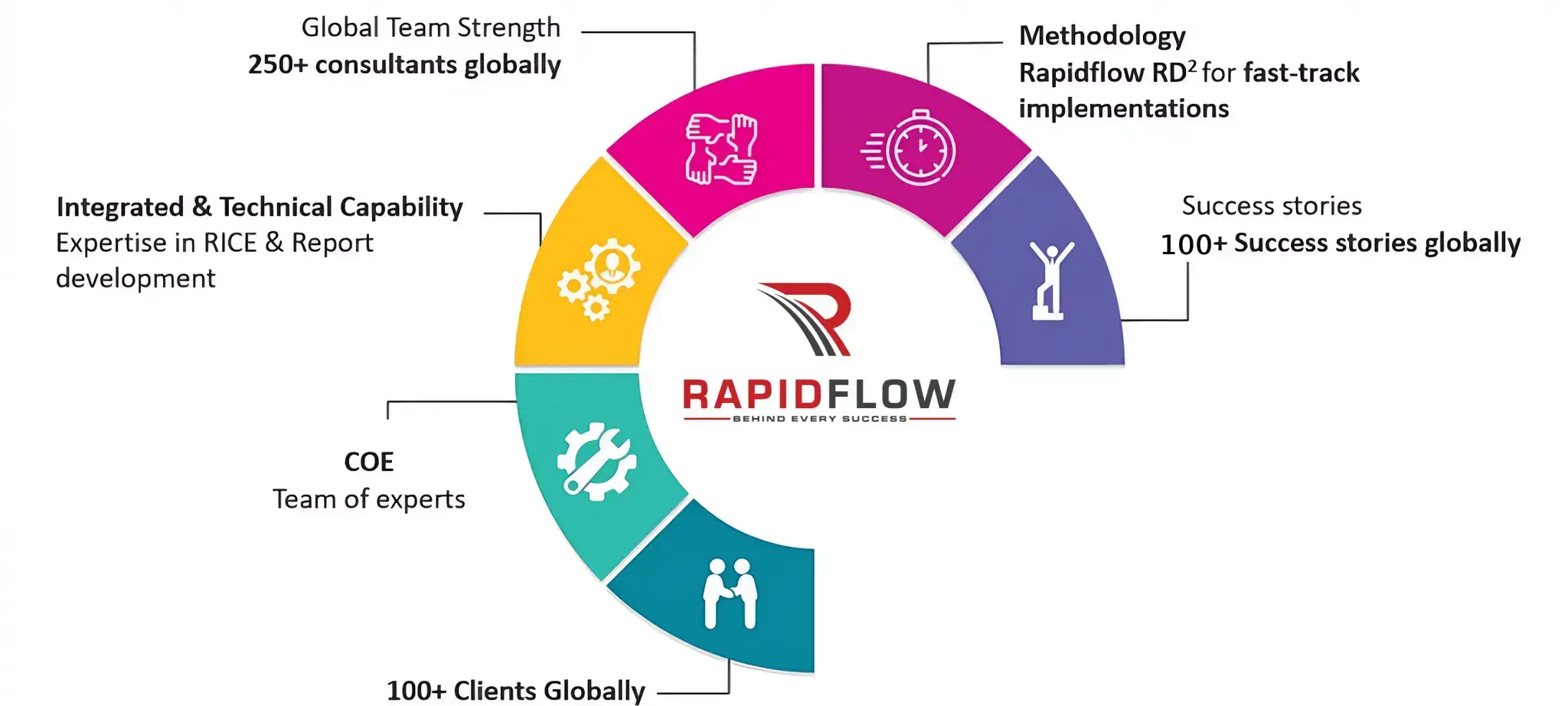
  • Rapidflow is a global professional services company and a leading Oracle Partner, with over 13 years of expertise and capabilities in Oracle products and technologies. The company has specialized skills across multiple industry domains and a global team of more than 250 consultants spread across office locations in the US, India, and the Middle East.
  • Rapidflow offers a range of services including End-to-End Implementation, System Integration, and Application Management Services (AMS) for Oracle Fusion Cloud, Oracle E-Business Suite, NetSuite, and RPA (Robotic Process Automation). The company’s unique methodology, Rapid Discovery & Design (RD²) combines with Oracle Unified Method (OUM) to deliver efficient and effective solutions to the  clients.
Why Rapidflow
  • Rapidflow’s team of experts with deep domain and technical knowledge, coupled with their experience in delivering large-scale, complex projects, makes it a trusted partner for Oracle-based solutions. We understand client’s unique business requirements and provide customized solutions that align with the client’s business objectives, sets it apart in the industry. Rapidflow’s focus on delivering quality solutions, on-time and within budget, ensures a rapid return on investment for their clients.
  • Rapidflow is a leading consulting company in the area of Oracle Supply Chain, Product Lifecycle Management, Master Data Management and Business Intelligence. Our focus is on delivering quality solutions through its Rapidflow Implementation Methodology, with real-world experience and unmatched applications expertise, Rapidflow ensures not only implementation success but also guarantees a rapid return on investment for its clients. The company’s team-driven approach helps its clients achieve their corporate goals and maximize operational and financial performance. Rapidflow provides its customers with accelerated business flows and Oracle-based productivity solutions that help organizations improve their efficiency, visibility, and security of their business processes, and make data-driven decisions.

Featured Insights

Unlocking the Power of Gen AI

Generative AI in Oracle EPM Narrative Reporting: Automate Financial Storytelling

Finance teams spend hours writing what AI can generate in seconds. Oracle EPM generative AI eliminates the manual effort behind financial commentary – turning complex EPM data into clear, CFO-ready narratives automatically, within your existing Oracle EPM Cloud environment. <h2″>What Is Generative AI in Oracle EPM Narrative Reporting? Gen AI in Oracle EPM Narrative Reporting automates the creation of financial commentary, variance explanations, and management reports using large language models integrated within Oracle EPM Cloud. Instead of analysts writing period-end narratives by hand, AI interprets structured financial data and generates professional, context-aware text – consistently and in real time. This is not a standalone tool. It is a native capability within Oracle EPM Cloud, powered by OCI Generative AI services – meaning no separate AI platform, no additional infrastructure. How Gen AI Automates Financial Narrative Creation in Oracle EPM Oracle EPM AI narrative automation works in four steps: Data Ingestion: Gen AI pulls financial data directly from your Oracle EPM Cloud environment – actuals, budgets, forecasts, and variances – using the current Point of View (POV) selection. Variance and Trend Detection: The AI model identifies significant movements, anomalies, and trends across the selected data view – segment, entity, period, or scenario. Narrative Generation: Using conditional text and large language model logic, Oracle EPM gen AI automation produces human-readable commentary aligned to the data – rewriting dynamically as the POV changes. Real-Time Refresh: As users navigate across entities, periods, or segments, the narrative updates automatically – ensuring commentary always reflects the current data view without manual intervention. Generative AI Workflow Key Benefits: Speed, Accuracy, and CFO-Ready Insights Capability Business Benefit Auto-generate commentary Reduces report production time by up to 70% Smart summarization Focuses narratives on material variances and trends Real-time narrative refresh Commentary stays aligned to live EPM data Context-aware explanations Surfaces reasons behind variances automatically Multilingual generation (NLG) Supports global reporting and compliance requirements AI financial reporting through Oracle EPM Cloud delivers consistent narrative quality across every report cycle – removing the dependency on individual analyst availability and reducing the risk of manual errors in period-end commentary. Use Cases: Gen AI for EPM Commentary, Variance Analysis and Forecasting Management Reporting: Auto-generate executive summaries and board-ready commentary for P&L, Balance Sheet, and Cash Flow reports – aligned to organizational tone and policy. Variance Analysis: AI-powered financial narrative reporting Oracle Cloud identifies and explains budget-versus-actual variances at segment, entity, and period level – without manual annotation. Forecast Narratives: Generate forward-looking commentary from EPM forecast data, giving FP&A teams a consistent starting point for scenario planning discussions. Segment and Entity Reporting: As POV selection changes across segments or entities, Oracle EPM AI financial storytelling rewrites narrative commentary in real time – eliminating repetitive manual updates across report versions. How Rapidflow Implements Gen AI within Oracle EPM Cloud Rapidflow is a trusted Oracle Partner offering end-to-end Oracle EPM Cloud implementation including Gen AI narrative reporting configuration. Our implementation approach covers: Oracle EPM Cloud environment assessment and Gen AI readiness review OCI Generative AI integration and configuration within your existing EPM setup Conditional text framework design aligned to your reporting structure POV navigation and dynamic narrative refresh configuration User acceptance testing across P&L, variance, and forecast report types Finance team enablement and narrative governance setup Typical Oracle EPM gen AI automation implementation timelines range from 6–12 weeks depending on data complexity, existing EPM configuration, and business requirements. Getting Started: Oracle EPM Gen AI Rollout Checklist Confirm Oracle EPM Cloud subscription includes OCI Gen AI service access Identify two to three high-impact reports to activate first – P&L and variance reports deliver fastest visible value Define narrative tone, terminology standards, and organizational language guidelines before configuration Map POV dimensions – year, entity, segment – to narrative trigger conditions Gather feedback from finance users after first two close cycles to refine narrative accuracy and relevance Test Case- Summary How Oracle Gen AI Narration Works with POV Navigation Navigating POV updates the data view Year, entity, segment selection changes the displayed data Gen AI analyzes the displayed data dynamically Processes the current view in real-time Uses Conditional Text to generate AI-driven narration Creates context-specific commentary for selected data Narration rewrites automatically with each POV change Ensures commentary always matches current view Provides real-time, tailored summaries Highlights key trends and figures relevant to selection As you navigate and select different POVs, Oracle Gen AI dynamically rewrites the narrative to match the current data, providing clear, instant explanations without manual effort. Here are a few additional examples listed below Revenue Reports: All segments Net Revenue for the year 2024 All segments Net Revenue for the year 2025 Electronics, Net Revenue for the year 2025 Frequently Asked Questions Everything you need to know about Gen AI in Oracle EPM 01 What is Generative AI in Oracle EPM Narrative Reporting? + Gen AI in Oracle EPM Narrative Reporting automates the creation of financial commentary, variance explanations, and management reports using large language models integrated within Oracle EPM Cloud. 02 How does Oracle EPM use AI to automate narrative reports? + Oracle EPM leverages AI agents and Gen AI models to pull financial data, detect variances, and auto-generate human-readable narratives – reducing manual effort by up to 70%. 03 Can generative AI replace financial analysts in EPM reporting? + No. Gen AI augments analysts by automating routine commentary so teams can focus on strategic interpretation and decision-making. 04 Is Oracle EPM Gen AI available on Oracle Cloud? + Yes. Oracle EPM Cloud integrates with OCI Generative AI services, enabling AI-powered narrative automation within the existing EPM environment. 05 What are the business benefits of AI in Oracle EPM? + Faster close cycles, consistent narrative quality, reduced manual errors, and real-time commentary aligned to CFO expectations. 06 How long does it take to implement Gen AI in Oracle EPM? + Typical implementation timelines range from 6–12 weeks depending on data complexity, existing EPM configuration, and business requirements. 07 Does Rapidflow offer Oracle EPM Gen AI implementation services? + Yes. Rapidflow is an Oracle


Read More »
standard-quality-control-collage-concept

AI in Product Lifecycle Management: Smarter Descriptions, Better Customer Experiences

In the digital marketplace, first impressions happen in seconds – often through words. For enterprises managing thousands of SKUs, AI product lifecycle management Oracle delivers what manual processes never could: consistent, SEO-optimized, customer-ready product descriptions at scale. For product managers, creating feature-rich and accurate descriptions across large catalogs is time-consuming, error-prone, and disconnected from what customers actually want to read. Oracle Fusion Cloud changes that with AI-powered product descriptions PLM – turning dry product data into engaging narratives automatically. Why AI Is Transforming Oracle Product Lifecycle Management AI product lifecycle management Oracle is no longer a future capability – it is live, embedded, and delivering measurable results across manufacturing, retail, and high-tech enterprises today. How AI Generates Smarter Product Descriptions Automatically Oracle’s embedded Generative AI models – tuned specifically for SCM and PLM workflows – follow a straightforward three-step process: Input: Item master attributes – codes, dimensions, supplier details, use cases – are fed directly from the Oracle PLM Cloud environment. AI Processing: Oracle AI for product data management transforms raw attributes into fluent, human-readable text aligned to brand tone and catalog standards. Output: Draft descriptions in natural language – ready to review, approve, and publish across every channel. Before (Code-Only): INK-BLK-20L After (AI-Generated): Industrial Black Ink, 20-litre container. High-density formula for large-scale printing and manufacturing. Supplied by XYZ with a shelf life of 18 months. One is a code. The other is a story. Generative AI in Oracle PLM also supports: Attribute-to-sentence transformation – specs become clear, readable sentences Accuracy preservation – no creativity at the cost of compliance Catalog consistency – standard language enforced across every SKU AI Assist regeneration – descriptions can be reframed instantly without starting from scratch Oracle AI PLM: Key Capabilities and Integrations </h3 > AI-powered product descriptions PLM sits within a broader set of Oracle AI capabilities across the product lifecycle: Item classification and tagging – AI recommends product categories and attributes based on historical data patterns Compliance flagging – AI identifies missing regulatory fields before products reach market Cross-channel consistency – one AI-generated description adapts to e-commerce, distributor catalogs, and mobile apps without manual rework Supplier collaboration – cleaner item data reduces back-and-forth with suppliers across regions and partner networks Inventory deduplication – consistent descriptions reduce redundant items in the catalog For companies asking how to automate product data with AI Oracle PLM Cloud, these capabilities work together as a unified layer within the existing Oracle Cloud environment – no separate platform required. Business Impact: Faster Time-to-Market with AI-Powered PLM The business case for Oracle AI PLM for manufacturing and retail is straight forward: 40% faster with fewer manual bottlenecks in product setup Search-driven discovery improves as AI-generated descriptions naturally incorporate relevant keywords Conversion rates on high-value items increase when descriptions clearly communicate benefits Customer support queries drop when product usage and features are explained clearly upfront Procurement efficiency improves as clean, consistent catalog data eliminates confusion over duplicate or vague items A leading consumer electronics retailer managing over 25,000 SKUs saw immediate improvements after implementing Oracle’s AI-powered Item Description Generation – reduced bounce rates, higher conversion on high-value items, and a significant drop in “what does this product do” support queries. Industries Benefiting Most from AI in PLM Retail and E-Commerce Thousands of fast-moving SKUs need crisp, compelling descriptions to win digital shelf space. AI-powered product descriptions for e-commerce PLM deliver consistent, conversion-optimized content at catalogue scale. Manufacturing Oracle AI PLM for manufacturing and retail reframes complex technical specifications into benefit-driven language – helping customers and sales teams quickly understand product value across multi-SKU environments. Healthcare and Medical Devices Precise yet clear descriptions ensure regulatory compliance while making product usage understandable to both clinical professionals and end-users. Industrial Equipment Technical attributes become approachable narratives – accelerating procurement decisions and reducing supplier communication cycles. AI Assist button that generates the Product description AI Assist button that re-generates/reframes the generated description The difference? One is a code. The other is a story. Rapidflow’s Oracle PLM AI Implementation Approach Rapidflow specializes in Oracle PLM Cloud implementation and integrates AI-driven automation for product data management across manufacturing, retail, and high-tech enterprises. Our implementation approach covers: Oracle PLM Cloud environment assessment and AI readiness review AI item description generation configuration aligned to your catalog structure and brand tone Item master data mapping and attribute-to-narrative template design Integration with Oracle SCM Cloud, e-commerce platforms, and distributor systems User acceptance testing across product categories and SKU volumes Finance and product team enablement for AI-assisted catalog governance Frequently Asked Questions Everything you need to know about AI route optimization 01 What is AI in Product Lifecycle Management (PLM)? + AI in PLM uses machine learning and natural language generation to automate product data entry, generate descriptions, flag compliance issues, and accelerate product launches. 02 How does Oracle use AI in PLM? + Oracle integrates AI across its PLM Cloud to auto-generate product descriptions, classify items, and recommend design changes based on historical data. 03 What are the benefits of AI-powered product descriptions in PLM? + AI-generated descriptions are consistent, SEO-optimized, faster to produce, and reduce errors – leading to better customer experiences and higher conversion rates. 04 Can AI in PLM help reduce time-to-market? + Yes. AI automates repetitive data tasks in product setup, enabling teams to launch products up to 40% faster with fewer manual bottlenecks. 05 Is Oracle AI PLM suitable for manufacturing companies? + Absolutely. Manufacturing, retail, and high-tech companies benefit most from Oracle AI PLM for complex product catalogues and multi-SKU environments. 06 Does Rapidflow implement Oracle PLM with AI capabilities? + Yes. Rapidflow specializes in Oracle PLM Cloud implementation and integrates AI-driven automation for product data management.

Read More »
Boosting Productivity

Boosting Supply Chain Productivity with AI-Powered Lead-Time Insights

In supply planning, productivity does not just mean working harder – it means working smarter. Yet planners often find themselves buried in spreadsheets, reconciling supplier promises while hours are lost figuring out why orders are late, which suppliers can be trusted, and where to focus first. The result? Slow decisions, missed opportunities, and planners left exhausted. Oracle SCM Cloud AI is changing that with AI-powered lead-time insights – turning the invisible into visible, and the messy into manageable. For enterprises asking how AI improves lead time insights in supply chain, the answer starts with giving every planner precision, clarity, and real-time intelligence at their fingertips. What Are Lead-Time Insights and Why AI Changes Everything AI lead time optimization supply chain goes far beyond tracking whether a shipment is late. Traditional supply planning relies on static lead times – fixed numbers that rarely reflect real supplier behavior. AI replaces that with dynamic, data-driven intelligence. AI lead-time insights use machine learning to analyze historical supplier data, detect patterns, and predict future delivery timelines – helping planners proactively manage disruptions before they impact production schedules. The shift is fundamental: from reacting to delays after they happen, to anticipating and preventing them before they occur. For procurement teams managing hundreds of suppliers across global networks, AI lead time insights for procurement teams means fewer surprises, faster decisions, and a supply chain that runs on facts rather than assumptions. How AI Predicts and Optimizes Supplier Lead Times AI-powered lead time prediction Oracle SCM works through two core capabilities that together give planners complete visibility: The Supplier Variance Table – Precision at Scale The first step is clarity. With the Supplier Variance Table, the fog lifts: Average days late per supplier Variance percentages across order history Historical performance trends over configurable time periods Cold, hard numbers reveal who is delivering as promised and who is quietly drifting off course – with no hiding behind vague excuses or anecdotes. This precision allows planners to prioritize with confidence: focus on the few suppliers causing the most disruption instead of spreading energy thin. The Order Details View – Every Order, Every Detail Boosting supply chain productivity with AI lead time analytics also means finding the fine cracks before they spread. With the Order Details View, each shipment becomes a case file: Ordered quantity and date Received quantity and date Variance marked and flagged automatically Delays stop being abstract trends and become individual stories of movement and misstep. This order-by-order transparency uncovers the hidden causes of variance – a bottleneck at customs, a carrier delay, or a supplier batching orders inefficiently. Planners are not firefighting. They are problem-solving. Oracle SCM AI: Lead-Time Intelligence Built In Key capabilities built into Oracle SCM AI include: Dynamic lead-time recalculation – AI continuously updates lead time estimates based on the latest supplier performance data Anomaly detection – outlier shipments are automatically flagged for planner review before they cascade into production delays Supplier risk scoring – AI scores suppliers by reliability, giving procurement teams an objective basis for sourcing decisions Real-time alerting – planners receive proactive notifications when lead time variance exceeds defined thresholds Integration with demand planning – lead time intelligence feeds directly into supply planning workflows, aligning procurement with actual demand signals For organizations evaluating Oracle AI for supplier lead time management, these capabilities operate within the existing Oracle Cloud environment – activated through configuration, not a new implementation. From Reactive to Proactive: AI-Driven Supply Planning The productivity lift from AI lead time optimization supply chain comes in multiple dimensions: Industrial Manufacturing In industries where downtime costs millions per hour, productivity depends on proactive planning. Supplier Variance Tables highlight which parts of the network are unreliable, letting planners focus energy where it matters most preventing costly downtime. Faster decisions – prioritize the top variance drivers instantly without manual data gathering Smarter supplier meetings – walk into performance reviews with facts, not guesswork Focused interventions – fix root causes instead of patching symptoms quarter after quarter Reduced planning errors – organizations using AI lead-time analytics typically see 15–30% reduction in planning errors and significant improvements in on-time delivery rates AI-powered lead time prediction enterprise transforms supply planning from a reactive discipline into a genuinely proactive one – where disruptions are anticipated, not discovered. Measuring Productivity Gains with AI Lead-Time Analytics Pharmaceuticals Drug supply chains are regulated and time-sensitive. AI lead time insights allow planners to spot recurring supplier delays at the batch level – enabling faster corrective actions and ensuring products reach patients without delay. Industrial Manufacturing Where downtime costs millions per hour, productivity depends on proactive planning. Supplier Variance Tables highlight which parts of the network are unreliable, letting planners focus energy where it matters most. Consumer Packaged Goods (CPG) Fast-moving products leave little margin for inefficiency. By investigating shipment-level details, planners identify chronic bottlenecks – such as repeated carrier delays – address them, and keep the supply chain flowing smoothly. Mini Case: Pharma Company Doubles Planner Efficiency A mid-sized pharmaceutical manufacturer struggled with recurring supplier delays, often uncovered only when production schedules had already slipped. Planners spent hours chasing shipment details across emails and spreadsheets. After deploying Oracle Lead-Time Insights AI, the team relied on the Supplier Variance Table and Order Details View to pinpoint the worst offenders. In just one quarter: Planner investigation time dropped significantly Supplier performance review meetings became data-driven, cutting preparation time in half Corrective actions were logged and tracked order-by-order, reducing repeat delays With AI lead time optimization supply chain, productivity is no longer about adding more hands on deck. It is about giving every planner the power of visibility, precision, and clarity – so the entire supply chain works faster, smoother, and sharper. Rapidflow’s Approach to Oracle SCM AI Implementation Rapidflow is an Oracle Partner with deep expertise in Oracle SCM Cloud AI features including lead-time optimization and supply chain analytics. Our implementation approach covers: Oracle SCM Cloud environment assessment and AI lead-time feature readiness review Supplier Variance Table and Order Details View configuration aligned

Read More »
Talk to Your Policy

Talk to Your Policy: How Conversational AI Agents Transform Insurance Queries

Health insurance questions never come at the right time. They arrive in moments of urgency – right before a hospital admission, while filling out claim forms, or when an unexpected medical bill lands in your inbox. Picture this: A new parent wonders: “Will my baby be covered under my policy from birth?” An employee working late asks: “Does my plan cover emergency room visits?” Another preparing for surgery asks: “What is the pre-approval process for cashless treatment?” The answers exist – but they are locked inside dense policy documents, buried across HR portals, or waiting in an overflowing inbox. By the time clarity arrives, the employee has already wasted time and experienced unnecessary stress. This is exactly what conversational AI agents for health insurance queries solve. They transform complex policy documents into a simple, always-available dialogue – giving employees instant, accurate, policy-backed answers in plain language, without waiting for HR. This is the power of natural language AI for insurance customer service – and it is changing how enterprises manage policy communication at scale. Why Insurance Queries Are Ripe for AI Transformation Insurance query management is one of the highest-volume, most repetitive challenges in enterprise HR and customer service operations. Studies consistently show that the majority of employee insurance queries fall into a small set of categories – coverage limits, claim processes, network hospitals, pre-authorization requirements, and policy exclusions. These are not complex judgment calls. They are document lookup tasks – and document lookup is exactly where conversational AI insurance automation delivers its fastest and most measurable value. The traditional model has three failure points: employees cannot find answers quickly in dense documents, HR teams spend disproportionate time on repetitive queries, and the gap between question and answer creates friction at exactly the moments employees need support most. AI insurance policy query automation eliminates all three failure points simultaneously – giving employees instant self-service access, freeing HR teams for higher-value work, and ensuring every answer is grounded in the actual policy document. How Conversational AI Agents Answer Insurance Policy Questions How conversational AI agents transform insurance queries comes down to three capabilities working together: Natural Language Understanding Employees ask questions in plain, everyday language – not keywords or form fields. NLP insurance models interpret the intent behind the question, not just the words, enabling accurate responses even when questions are phrased informally or ambiguously. Retrieval-Augmented Generation (RAG) Rather than generating answers from general knowledge, enterprise conversational AI agents use RAG to search the actual policy documents stored in your environment – returning accurate, cited answers directly from the source. No hallucinations. No approximations. Just the policy clause, explained clearly. Context-Aware Conversation Unlike static FAQs or keyword-search tools, AI insurance agents maintain conversation context across follow-up questions. An employee can ask about maternity coverage, then ask a follow-up about pre-authorization for the same topic – and the agent understands the thread without the employee starting over. Workflow Triggering When a query moves beyond information retrieval – such as initiating a claim or submitting a reimbursement form – the conversational agent triggers the appropriate downstream workflow automatically, routing to the right system or escalating to HR only when genuine human judgment is required. Oracle AI: Building Insurance Chatbots on Enterprise Data For enterprises running Oracle Cloud environments, Oracle AI Agent Studio and Oracle Digital Assistant provide a native foundation for deploying AI insurance chatbots directly within Oracle Cloud CX and HCM. Oracle AI for insurance query automation offers: Policy document grounding – agents are configured against your actual policy documents, not generic insurance knowledge bases Oracle Cloud CX and HCM integration – query handling connects directly to HR portals, benefits systems, and claims workflows within the Oracle environment Role-based access controls – employees only receive policy information applicable to their specific plan and coverage tier Audit trail and compliance logging – every query and response is logged, supporting regulatory compliance and HR governance requirements Escalation to Action Center – exceptions and edge cases are routed automatically to HR or the insurance desk without manual monitoring For organizations on Oracle Cloud, this means AI insurance policy query automation is activated within the existing platform – no separate chatbot vendor, no new infrastructure. Real-World Use Cases: Health, Life, and Property Insurance AI Health Insurance – Employee Benefits Queries The highest-volume use case. Employees ask about coverage limits, cashless hospital networks, maternity benefits, pre-existing condition clauses, and claim submission processes. AI chatbots for insurance policy lookup resolve these instantly, reducing HR query volume by up to 60% in documented deployments. Life Insurance – Policy Status and Nomination Queries Employees and policyholders ask about sum assured, premium due dates, nomination updates, and policy surrender values. Conversational AI agents retrieve this information from policy records and guide users through update workflows where applicable. Property and Asset Insurance – Claims Initiation AI agents guide policyholders through first notice of loss, documentation requirements, and claim submission steps – reducing the time between incident and claim initiation and improving the accuracy of submitted claim documentation. Group Corporate Insurance – Multi-Policy Environments Large enterprises managing multiple group insurance policies across entities and geographies use conversational AI to ensure employees receive answers specific to their applicable policy – not generic responses that create confusion across plan variants. Customer Experience Gains from AI-Powered Insurance Agents The business case for natural language processing for insurance customer service is measurable across every deployment metric: HR query volume reduced by up to 60% on repetitive policy questions – freeing HR teams for strategic and exception-based work Instant first-contact resolution – employees get accurate answers in seconds rather than hours or days 24/7 availability – insurance queries do not follow business hours; AI agents do not either Consistent accuracy – every answer is grounded in the actual policy document, eliminating the risk of verbal miscommunication from overburdened HR representatives Faster claim initiation – employees guided through submission processes immediately rather than waiting for scheduled HR availability Improved employee satisfaction – clarity at the moment of need

Read More »
Vertex AI – Enabling

AI in Motion: Smarter Route Optimization for Leaner Logistics Costs

Transportation planning has always been about moving goods from A to B as efficiently as possible. But even the most advanced planning systems still relied on human planners comparing options, weighing carrier preferences, and manually adjusting routes – leaving room for costly decisions to slip through unnoticed. AI route optimization logistics changes that entirely. By learning from historical shipment data, carrier performance patterns, and real-time network conditions, AI does not replace transportation planning – it makes every planning decision smarter, faster, and measurably leaner before a single truck leaves the dock. Why AI Is Revolutionizing Transportation Route Planning The hidden cost of traditional transportation planning is not the routes that go wrong – it is the small inefficiencies that quietly accumulate across hundreds of shipments. Trucks running half-full. Costlier carriers selected when better options existed. Consolidation opportunities missed because planners were managing too many variables simultaneously. Across a large distribution network, these small misses do not stay small. They compound into significant cost leakage – and because they happen gradually and across many individual decisions, they are nearly impossible to detect and correct without AI. Smart route planning AI enterprise addresses this at the source. Instead of planners catching inefficiencies after the fact, AI surfaces the optimal decision before it is made – factoring in carrier reliability, lane performance history, load consolidation opportunities, fuel cost, and delivery time commitments simultaneously. The shift is from overspend to smart spend – and it happens at every shipment, across every lane, at scale. How AI Algorithms Optimize Routes in Real Time How AI optimizes transportation routes to reduce logistics costs operates across three layers of intelligence working together: Historical Pattern Learning AI analyzes past shipment data – which carriers consistently overcharge, which lanes underperform on delivery reliability, which consolidation patterns reduce cost without compromising service levels. These patterns become the baseline for every future routing decision. Real-Time Constraint Processing Traffic conditions, weather events, carrier capacity availability, and delivery time windows are processed in real time – adjusting route recommendations dynamically as conditions change rather than locking planners into static plans built hours earlier. Load Consolidation Intelligence One of the highest-value outputs of AI-powered smart routing for supply chain Oracle is load consolidation. Instead of shipping product lines separately on individual runs, AI identifies consolidation opportunities automatically – combining compatible shipments onto fewer vehicles across optimized sequences. Practical Example: A distribution hub managing tablets, smartphones, and laptops shipping to multiple locations: Before AI: Every product line shipped separately from the hub to each location – duplicated trips, higher fuel costs, inefficient carrier utilization After AI: Consolidation routes automatically generated – Tablets → Smartphones → Laptops combined in a single optimized run, with secondary consolidations identified across remaining lanes Key Insight Same deliveries. Fewer trucks. Optimized miles. Lower cost per unit shipped Oracle TMS + AI: Smarter Routing Built Into Your Supply Chain Oracle Transportation Management System (TMS) has AI and ML capabilities built directly into its planning and execution layer – meaning AI route optimization is not a separate tool bolted onto your existing process. It operates within the same environment your planners already use. Key Oracle TMS AI capabilities for logistics optimization include: AI-powered route scoring – every route option is scored against cost, reliability, and service level simultaneously before planners select Carrier performance memory – the system retains carrier track record data and factors it into future routing recommendations automatically Multi-modal optimization – AI optimizes across road, rail, air, and ocean freight within a single planning interface Freight cost prediction – Oracle transportation management AI optimization predicts total freight spend per route before commitment, surfacing savings opportunities proactively Automated consolidation suggestions – load consolidation opportunities are surfaced automatically, reducing the manual effort of shipment grouping For enterprises already running Oracle SCM Cloud, Oracle TMS AI activation is a configuration exercise within the existing platform – not a new implementation from scratch. Cost Reduction Outcomes: Real Numbers from AI Route Optimization The business case for AI transportation cost reduction Oracle is well-documented across enterprise deployments: Enterprises typically see 10–25% reduction in transportation costs with AI-powered routing across established networks Up to 30% improvement in on-time delivery performance as AI routing accounts for carrier reliability alongside cost Significant reduction in empty miles through load consolidation intelligence – directly reducing fuel spend and carrier utilization cost Planner productivity gains as AI pre-optimizes route options, reducing the time planners spend manually comparing alternatives before each shipment cycle Elimination of repeat costly decisions – AI remembers which lanes and carriers consistently underperform and avoids repeating expensive patterns For AI for last-mile delivery cost reduction enterprise, the compounding effect of consistent AI-driven decisions across high shipment volumes delivers savings that grow proportionally with network scale. Use Cases: Retail, Manufacturing, and Distribution Logistics AI Retail and E-Commerce High shipment frequency and tight delivery windows make AI route optimization essential for retail logistics. AI consolidates outbound shipments, optimizes carrier selection across last-mile networks, and reduces the cost per delivery on high-volume SKU movements. Manufacturing and Industrial Inbound raw material and component logistics benefit from AI lead-time-aware routing – ensuring production schedules are not disrupted by carrier reliability failures on critical supply lanes. FMCG and Consumer Goods Fast-moving product distribution requires balancing cost and speed across dense delivery networks. AI identifies consolidation opportunities across SKUs and delivery zones, reducing transportation spend without compromising shelf availability. Third-Party Logistics (3PL) 3PL providers managing multi-client networks use AI route optimization to maximize fleet utilization across clients – improving margin on every route while maintaining client-specific service level commitments. Distribution and Wholesale Multi-location distribution hubs use leaner logistics costs with AI route planning to reduce duplicated runs across overlapping delivery zones – consolidating shipments intelligently and cutting total fleet kilometers without changing delivery commitments. Getting Started with Oracle AI Transportation Management Rapidflow is an Oracle Partner with expertise in Oracle SCM and Transportation Management System AI implementations. Our approach to Oracle TMS AI deployment covers: Oracle TMS environment assessment and AI route optimization readiness




Read More »
Unlocking Context

Experience Claims Like Never Before: AI-Powered Swift and Simple Claims Processing

“I submitted all the documents last week – why is my accident claim still under review?” This is one of the most common questions policyholders ask. And too often, it is met with silence or vague responses. The reality is that most insurers still rely heavily on manual processes to validate claims – a task that is both time-consuming and error-prone. In high-stress scenarios – when a person is injured, a car is totaled, or medical bills are rising – speed and clarity are everything. That is why insurers are turning to AI insurance claims processing automation to handle claims with the speed, accuracy, and transparency today’s policyholders expect. The Problem with Traditional Insurance Claims Processing Insurance claims are far from simple paperwork. Each claim involves a vast array of documents – emergency medical records, police reports, diagnostic tests, repair invoices, and treatment summaries. Insurers must carefully verify every detail against complex and ever-evolving policy terms, eligibility criteria, coverage limits, and exclusions. This manual process creates four compounding problems: Volume overload – growing claim volumes overwhelm teams operating with fixed headcount, creating backlogs that delay every policyholder regardless of claim complexity Inconsistent decisions – manual review introduces human variability, meaning identical claims can receive different outcomes depending on which adjuster handles them Fraud exposure – manual review processes lack the pattern recognition capability to reliably identify fraudulent claims across high volumes Customer trust erosion – delayed and unclear claim decisions hurt satisfaction and loyalty precisely when policyholders are most vulnerable and most likely to remember the experience With automated insurance claims management with AI, each of these failure points is addressed systematically – not patched individually. How AI Transforms the End-to-End Claims Experience How AI speeds up insurance claims processing works across every stage of the claims lifecycle – from the moment a policyholder submits their first document to the moment a settlement is confirmed: Document Intake and Classification AI automatically ingests, classifies, and extracts relevant data from all claim-related documents – medical records, repair estimates, police reports, and supporting evidence – regardless of format. What previously required manual sorting and data entry across multiple systems happens in seconds, with full extraction accuracy. Policy Eligibility and Coverage Verification AI cross-references extracted claim data against the policyholder’s active coverage, exclusions, waiting periods, and benefit limits – flagging mismatches, missing documentation, and eligibility issues automatically. Every verification is logged with a documented audit trail. Damage and Liability Assessment For motor and property claims, AI models analyze submitted evidence – photos, repair invoices, third-party reports – to assess damage extent and estimate settlement ranges aligned to policy terms. For health claims, AI validates procedure codes, treatment duration, and provider network eligibility against plan rules. Fraud Detection and Anomaly Flagging AI-powered claims experience for policyholders requires the insurer to get fraud detection right. AI models analyze patterns across thousands of claims simultaneously – flagging duplicate submissions, inconsistent documentation, unusual claim timing, and behavioral anomalies that manual reviewers would miss across high volumes. Settlement Calculation and Decision Generation Based on verified eligibility, assessed damage, and applicable policy rules, AI calculates the payable settlement amount and generates a decision with a clear, documented rationale – giving policyholders transparent explanations rather than opaque outcomes. Human Escalation for Complex Cases Low-confidence determinations, disputed claims, and edge cases outside defined parameters are automatically escalated to human reviewers with a complete case summary attached – ensuring human oversight is applied where it genuinely adds value, not consumed by routine processing. Test Case: Oracle AI Capabilities for Insurance Claims Automation From First Notice of Loss to Settlement: AI at Every Step Oracle AI for insurance claims automation enterprise covers the complete claims journey: Step 1 – First Notice of Loss (FNOL) Policyholder submits claim via portal, mobile app, or customer service channel. AI immediately acknowledges receipt, confirms document requirements, and initiates the intake workflow – eliminating the manual triage step that creates the first delay in traditional processing. Step 2 – Document Collection and Validation AI monitors document completeness in real time, automatically requesting missing items from the policyholder and confirming receipt when submitted. No claim sits idle waiting for a human to notice a missing document. Step 3 – Eligibility and Coverage Assessment AI verifies policyholder eligibility, active coverage, applicable exclusions, and waiting period status against the submitted claim details – producing a verified eligibility summary within minutes of document completion. Step 4 – Assessment and Calculation Damage assessment, liability determination, and settlement calculation are performed by AI against policy rules – with every calculation documented and traceable for audit purposes. Step 5 – Decision and Communication Approved settlements are communicated to the policyholder with a clear breakdown of the decision. Partial approvals include documented rationale for each line item. Escalated cases are transferred to human reviewers with a complete AI-prepared case summary. Step 6 – Settlement Processing Approved settlements trigger downstream payment workflows automatically – connecting to billing, finance, and payment systems without manual re-entry. Customer Impact: Faster Resolution, Higher Satisfaction The measurable impact of reducing claims processing time with AI technology is consistent across enterprise deployments: 40–60% reduction in claims processing time – from submission to settlement decision, documented across AI claims automation implementations Up to 75% reduction in claim resolution time for standard, well-documented claims processed entirely within AI-defined parameters Significantly improved first-contact resolution – policyholders receive accurate status updates and document guidance at every stage rather than waiting for callbacks Consistent decision quality – identical claims receive identical treatment regardless of volume, time of day, or adjuster availability Fraud detection accuracy – AI models flag anomalies with higher consistency than manual review across high-volume claim environments Scalable operations – claim volume surges from seasonal events, weather incidents, or product launches are absorbed without increasing headcount Today’s policyholders expect more than coverage. They expect speed, transparency, and fairness. AI-powered claims experience for policyholders delivers all three – systematically, at every claim, at scale. Implementing AI Claims Processing with Rapidflow Rapidflow designs and implements AI-powered claims workflows

Read More »

Boost Hiring Productivity with AI Agentic Automation

Imagine opening your email to find 800 job applications for a single position. Your heart sinks as you realize the mountain of paperwork ahead. This is the reality for HR teams everywhere spending countless hours sifting through resumes, trying to find the perfect candidates while the clock ticks and top talent slips away to faster competitors. What if we told you there’s a way to turn this overwhelming challenge into your competitive advantage and boost productivity at the same time? With UiPath’s Agentic Automation for Resume Screening, companies are cutting weeks of manual work into hours, freeing up HR teams to focus on engaging top talent instead of sorting through piles of resumes. It is breakthrough solution that’s transforming how forward-thinking companies discover their next star employees. The Hidden Cost of Traditional Hiring Every day, talented HR professionals across industries face the same frustrating reality: Story of every HR: “We posted a marketing manager position and received 400 applications in three days. My team and I spent two full weeks just reading resumes. By the time we contacted our top choices, half had already accepted offers elsewhere. We were losing great people simply because we couldn’t move fast enough. When hiring needs to happen quickly, we often don’t have time to thoroughly review every resume. That’s how the best fit can slip through the cracks—without us even realizing it.” This scenario plays out thousands of times daily across companies of all sizes. The cost isn’t just time—it’s lost opportunities, delayed projects, and watching competitors snap up the best talent. Introducing Your New Hiring Superpower UiPath’s Agentic Automation Resume Screening is like having a tireless, unbiased hiring assistant that never sleeps, never gets tired, and never misses a qualified candidate. This innovative solution combines cutting-edge technology to automatically review, analyse, and rank candidates—turning weeks of work into hours of results. Think of it as your personal hiring detective that can: Read and understand any resume format instantly Remember every job requirement perfectly Compare hundreds of candidates fairly and consistently Provide clear explanations for every decision Work 24/7 without coffee breaks How This Game-Changing Solution Works Let’s see how agentic automation transforms your hiring process: Test Case:- Why This Solution is a Business Game-Changer Fast Hiring In today’s competitive market, the fastest employer often wins the best candidates. While your competitors spend weeks in resume review, you’re already scheduling final interviews. Fair Screening Every candidate gets evaluated using the same high standards. No more wondering if different team members have different criteria or unconscious biases affecting decisions. Scalability Whether hiring 1 person or 100, the system handles increased volume without breaking a sweat. Perfect for growing companies, seasonal hiring, or unexpected rapid expansion. Better Quality Better screening means better hires. When you consistently identify the most qualified candidates, you reduce turnover, improve performance, and save thousands in re-hiring costs. Transparency Every decision comes with clear documentation and reasoning, supporting fair hiring practices and providing valuable feedback for continuous improvement. Business Impact Perfect for Every Industry, Every Size Growing Startups Scale your hiring without scaling your HR overhead. Focus founder time on vision and strategy, not resume review. Enterprise Corporations Handle high-volume hiring efficiently across multiple departments and locations while maintaining consistent standards. Seasonal Businesses Quickly ramp up hiring for peak seasons without the traditional bottlenecks and delays. Specialized Industries Whether you need healthcare professionals, engineers, or creative talent, the system adapts to industry-specific requirements and terminology. What This Means for Your Organization Imagine walking into work knowing that: Your job postings automatically attract and filter the best candidates Your HR team focuses on strategic initiatives instead of paperwork Your hiring managers interview only pre-qualified, excited candidates Your company reputation improves as candidates receive faster, more professional responses Your competitive advantage grows as you consistently out-hire the competition The Future of Hiring is Here This isn’t science fiction—it’s business reality. Forward-thinking companies are already gaining unfair advantages in the talent market while their competitors struggle with outdated, manual processes. The question isn’t whether this technology will transform hiring—it already is. The question is whether your organization will lead this transformation or scramble to catch up later. Ready to Transform Your Hiring? Stop letting great candidates slip away while you’re buried in paperwork. Join the hiring revolution that’s helping companies of all sizes discover amazing talent faster, fairer, and more efficiently than ever before. Your next star employee might be hidden in your current pile of resumes. Don’t you want to find them before your competitors do? Take the first step toward effortless hiring. Your future team is waiting to be discovered.

Read More »

Stop Phishing at the Source: AI-Powered Enterprise Email Protection

You are wrapping up a long day. An email hits your inbox: “Urgent: Payment Confirmation Needed.” Familiar sender, professional formatting, just the right sense of urgency. You forward it to finance. But this time, it was not just another task. It was the beginning of a phishing attack. One click. One forward. And now your business faces a chain reaction – data breach, financial exposure, compliance risk, and reputational harm. This is not a technology failure. It is a human one. And it is exactly what AI enterprise email security phishing protection is built to prevent. Why Phishing Remains the #1 Enterprise Cyber Threat Human error is inevitable – especially under fatigue, pressure, or distraction. Even the most diligent employees can misjudge a situation. And that is precisely what attackers exploit. Modern phishing emails are no longer easy to spot. Attackers have moved beyond poorly worded scam messages to highly personalized, psychologically crafted communications – tailored to the recipient, the organization, and the moment. Spear-phishing and Business Email Compromise (BEC) attacks routinely bypass firewalls, spam filters, and employee training because they are designed to look completely legitimate. The consequences of a single mistake: Financial loss – fraudulent transfers, ransomware payments, and recovery costs Data breach – customer, employee, and partner data exposed Compliance exposure – GDPR, HIPAA, and SOX violations triggered by unauthorized data access Reputational damage – customer and partner trust eroded, often permanently The cost of a single phishing incident can range from thousands to millions depending on the scale and sensitivity of the exposure – and the damage is rarely detected until it is already done. How AI Detects and Blocks Phishing Emails in Real Time How AI stops phishing attacks at the source works across multiple simultaneous analysis layers – not a single filter: Email header and metadata analysis – sender reputation, domain age, routing anomalies, and spoofing indicators assessed before the message reaches the inbox Content and language pattern analysis – AI models identify urgency manipulation, impersonation language, and social engineering patterns invisible to rule-based filters URL and attachment risk scoring – embedded links and attachments are analyzed for malicious indicators, redirects, and known threat signatures in real time Behavioural baseline comparison – AI compares the email against the sender’s established communication patterns, flagging deviations that suggest account compromise or impersonation Contextual risk classification – each email is scored and classified – clean, suspicious, or malicious – with automated action triggered based on your organization’s defined security policy The result: AI phishing detection and prevention that catches what human judgment misses, consistently, at enterprise email volume. Machine Learning Models Behind Email Threat Intelligence What separates AI phishing protection from traditional email filters is continuous learning. Static rule-based filters work against known threats. Machine learning for enterprise email security Oracle models learn from new attack patterns as they emerge – including zero-day phishing campaigns that have never been seen before. Key ML capabilities in enterprise email threat detection: Supervised classification models – trained on millions of confirmed phishing and clean emails to score new messages with high accuracy Anomaly detection – unsupervised models identify unusual patterns in sender behavior, communication frequency, and content structure without requiring a known threat signature Natural language processing (NLP) – detects social engineering language, urgency manipulation, and impersonation tactics in email body content Continuous retraining – models update as new threat data is ingested, ensuring protection improves over time rather than degrading against evolving attacks The outcome: AI models that reduce false positives, catch sophisticated BEC and spear-phishing attacks, and improve with every email processed. Enterprise Email Security Integration UiPath agentic automation capabilities for email security include: UiPath AI agents that monitor incoming email traffic, classify threat level, and trigger automated response workflows in real time UiPath Action Center escalation – flagged emails routed to the IT security team with full context and risk classification attached Automated quarantine and user notification workflows configured to your internal security policy thresholds End-to-end audit trail across every AI classification decision and automated action taken For organizations on either platform – or both – AI-powered enterprise email phishing detection and prevention extends your existing security controls rather than replacing them. Building an AI-First Email Security Strategy for Your Enterprise Rapidflow specializes in Cloud security and AI implementations – designing and deploying enterprise email security strategies that combine AI threat detection, automated response workflows, and compliance controls across Oracle AI, UiPath Agentic Automation, and broader enterprise security platforms. Our approach covers: Current email security posture assessment – identifying gaps in existing filters, threat coverage, and incident response workflows Platform selection – Oracle AI security integration, UiPath agentic automation, or hybrid deployment based on your environment ML model configuration and calibration against your organization’s email traffic patterns Risk classification and automated response workflow design aligned to your internal security policies Integration with IT ticketing, security operations, and compliance reporting systems UiPath Action Center and Oracle security event escalation workflow configuration User awareness framework – AI backs up human judgment, not replaces it Ongoing threat model retraining and security performance monitoring Beyond Spam Filters: AI’s Multi-Layer Email Protection Approach Traditional spam filters operate on fixed rules – block known bad senders, flag certain keywords, quarantine attachments above a size threshold. They are effective against volume spam. They are not effective against targeted, sophisticated phishing. Real-time AI email threat detection enterprise goes further across every dimension: Capability Traditional Filter AI Protection Zero-day phishing detection ❌ No ✅ Yes Spear-phishing and BEC detection ❌ No ✅ Yes Behavioural anomaly detection ❌ No ✅ Yes Continuous learning from new threats ❌ No ✅ Yes False positive reduction over time ❌ Degrades ✅ Improves Automated risk-based response ❌ Limited ✅ Full workflow The difference is not incremental. It is structural – AI phishing protection for corporate email systems operates at a fundamentally different level of intelligence than any rule-based approach. Frequently Asked Questions Everything you need to know about AI route optimization 01 How does AI detect phishing emails in enterprises?



Read More »

Just Ask: How Natural Language AI Is Transforming Oracle Invoice Automation

It is the end of the month and the finance manager makes a simple request: “Can someone pull all the invoices from VendorX for this quarter?” What sounds straightforward quickly becomes a manual grind. The team dives into shared folders, email inboxes, and scattered file drives – sifting through PDFs, scans, and attachments in different formats. Hours are spent copying data into spreadsheets, checking for errors, and chasing payment deadlines under pressure. Now imagine a different approach. The manager types that same request into an intelligent system: “Find all invoices from VendorX for Q2 and extract invoice numbers, due dates, and amounts.” Within seconds, UiPath AI scans every folder, understands each document, identifies the relevant invoices, and extracts the exact data needed. No digging. No sorting. No manual entry. This is the power of AI invoice automation natural language processing – and it is transforming how enterprise finance teams operate. The Problem with Traditional Invoice Processing Manual invoice processing is one of the highest-volume, most error-prone workflows in enterprise finance. The structural problems are consistent across organizations: Fragmented document sources – invoices arrive via email, shared drives, supplier portals, and paper scans with no unified intake point Format inconsistency – PDFs, scanned images, Excel attachments, and EDI files require different handling, making automation with fixed rules unreliable Manual data extraction – finance teams manually key invoice data into ERP and AP systems, creating data entry errors, duplicate payments, and missed early payment discounts Approval bottlenecks – invoice approval workflows routed manually through email chains cause delays, lost approvals, and compliance gaps No conversational access – querying invoice status, finding specific vendor invoices, or checking payment timelines requires manual system navigation rather than a simple question NLP invoice processing enterprise eliminates each of these failure points – replacing manual effort with AI that understands plain English instructions and acts on them autonomously. Natural language AI in invoice automation allows finance teams to interact with invoice systems using plain English queries and commands – asking questions like “Find all overdue invoices from VendorX above $10,000” or “Check for duplicates across August invoices” and receiving instant, accurate results. Test Case: What Is Natural Language AI in Invoice Automation? “Find all invoices from VendorX in the July folder over $5,000” “Extract due dates and amounts from this month’s scanned invoices” “Check for duplicates across folders for August invoices” “Route all three-way match exceptions to the AP manager for review” UiPath AI agents combine natural language understanding, UiPath Document Understanding, and intelligent automation to scan folders, identify relevant documents, extract structured data, and complete AP workflows – all from a plain English instruction. No coding. No manual navigation. Just ask. UiPath Agentic AI: Conversational Invoice Processing in Action Unlike basic automation that follows fixed scripts, UiPath Agentic Automation thinks, adapts, and collaborates across complex invoice scenarios – handling unstructured documents, routing exceptions, and completing end-to-end workflows without human intervention unless genuinely needed. How it works in practice: Natural Language Instruction Received Finance team member types a plain English instruction – find, extract, match, route, or query – into the UiPath interface or integrated chat channel. AI Document Understanding UiPath Document Understanding processes every relevant document – regardless of format – extracting invoice numbers, vendor details, line items, amounts, due dates, and PO references with high accuracy across structured and unstructured formats. Intelligent Matching and Validation Extracted invoice data is automatically matched against purchase orders and goods receipts – flagging discrepancies, duplicate submissions, and missing documentation for exception handling rather than passing errors downstream. Automated Routing and Approval Validated invoices are routed through approval workflows automatically based on configured business rules – amount thresholds, vendor category, cost center, and payment terms – without manual routing intervention. Exception Escalation via Action Center Invoices that fall outside defined parameters – mismatched amounts, unrecognized vendors, missing PO references – are escalated to human reviewers through UiPath Action Center with full context attached, ensuring exceptions are resolved quickly without disrupting the straight-through processing flow. Conversational Status Queries Finance managers query invoice status, payment timelines, and vendor balances in plain English at any time – receiving instant answers from live AP data without manual system navigation. From PO Matching to Payment: AI at Every Invoice Step Just ask AI to process invoices naturally covers the complete accounts payable lifecycle with UiPath: Invoice intake – AI agents monitor email inboxes, shared drives, and supplier portals for new invoices, ingesting and classifying every document automatically Data extraction – UiPath Document Understanding extracts all relevant fields from any invoice format with high accuracy – reducing manual keying to zero for straight-through invoices Three-way PO matching – AI matches invoice data against purchase orders and goods receipts automatically, flagging discrepancies for human review Duplicate detection – AI scans the full invoice history to identify duplicate submissions before payment is triggered Approval workflow automation – invoices route through configured approval hierarchies automatically based on amount, vendor, and cost center rules <li Payment scheduling – approved invoices are scheduled for payment aligned to terms, capturing early payment discounts where applicable ERP posting – validated and approved invoices are posted to the connected ERP system automatically – no manual re-entry required Business Benefits: Speed, Accuracy, and Compliance The measurable impact of NLP-powered invoice automation for enterprise finance is consistent across deployments: 70–90% touchless processing rate achievable in well-configured UiPath invoice automation environments – meaning the majority of invoices are processed from intake to payment without human intervention Processing time reduced from days to minutes for standard invoices – AI processes documents simultaneously at any volume, not sequentially Duplicate payment errors eliminated through automated detection across the full invoice history before any payment is triggered Data entry errors removed from the AP process – AI extraction replaces manual keying across all invoice formats Approval cycle time compressed as invoices route automatically rather than waiting in email inboxes for manual forwarding Audit-ready compliance – every AI action, extraction decision, and approval routing step is logged with a complete audit

Read More »

Get expert advice on streamlining your business.
Schedule your free consultation now!

Our Clients

LinkedIn Icon Facebook Icon YouTube Icon
info@rapidflowapps.com

Explore Rapidflow AI

An accelerator for your AI journey