


Experience Claims Like Never Before: AI-Powered Swift and Simple Claims Processing


“I submitted all the documents last week – why is my accident claim still under review?”
This is one of the most common questions policyholders ask. And too often, it is met with silence or vague responses. The reality is that most insurers still rely heavily on manual processes to validate claims – a task that is both time-consuming and error-prone.
In high-stress scenarios – when a person is injured, a car is totaled, or medical bills are rising – speed and clarity are everything. That is why insurers are turning to AI insurance claims processing automation to handle claims with the speed, accuracy, and transparency today’s policyholders expect.
The Problem with Traditional Insurance Claims Processing
Insurance claims are far from simple paperwork. Each claim involves a vast array of documents – emergency medical records, police reports, diagnostic tests, repair invoices, and treatment summaries. Insurers must carefully verify every detail against complex and ever-evolving policy terms, eligibility criteria, coverage limits, and exclusions.
This manual process creates four compounding problems:
- Volume overload – growing claim volumes overwhelm teams operating with fixed headcount, creating backlogs that delay every policyholder regardless of claim complexity
- Inconsistent decisions – manual review introduces human variability, meaning identical claims can receive different outcomes depending on which adjuster handles them
- Fraud exposure – manual review processes lack the pattern recognition capability to reliably identify fraudulent claims across high volumes
- Customer trust erosion – delayed and unclear claim decisions hurt satisfaction and loyalty precisely when policyholders are most vulnerable and most likely to remember the experience
With automated insurance claims management with AI, each of these failure points is addressed systematically – not patched individually.
How AI Transforms the End-to-End Claims Experience
How AI speeds up insurance claims processing works across every stage of the claims lifecycle – from the moment a policyholder submits their first document to the moment a settlement is confirmed:
Document Intake and Classification AI automatically ingests, classifies, and extracts relevant data from all claim-related documents – medical records, repair estimates, police reports, and supporting evidence – regardless of format. What previously required manual sorting and data entry across multiple systems happens in seconds, with full extraction accuracy.
Policy Eligibility and Coverage Verification AI cross-references extracted claim data against the policyholder’s active coverage, exclusions, waiting periods, and benefit limits – flagging mismatches, missing documentation, and eligibility issues automatically. Every verification is logged with a documented audit trail.
Damage and Liability Assessment For motor and property claims, AI models analyze submitted evidence – photos, repair invoices, third-party reports – to assess damage extent and estimate settlement ranges aligned to policy terms. For health claims, AI validates procedure codes, treatment duration, and provider network eligibility against plan rules.
Fraud Detection and Anomaly Flagging AI-powered claims experience for policyholders requires the insurer to get fraud detection right. AI models analyze patterns across thousands of claims simultaneously – flagging duplicate submissions, inconsistent documentation, unusual claim timing, and behavioral anomalies that manual reviewers would miss across high volumes.
Settlement Calculation and Decision Generation Based on verified eligibility, assessed damage, and applicable policy rules, AI calculates the payable settlement amount and generates a decision with a clear, documented rationale – giving policyholders transparent explanations rather than opaque outcomes.
Human Escalation for Complex Cases Low-confidence determinations, disputed claims, and edge cases outside defined parameters are automatically escalated to human reviewers with a complete case summary attached – ensuring human oversight is applied where it genuinely adds value, not consumed by routine processing.
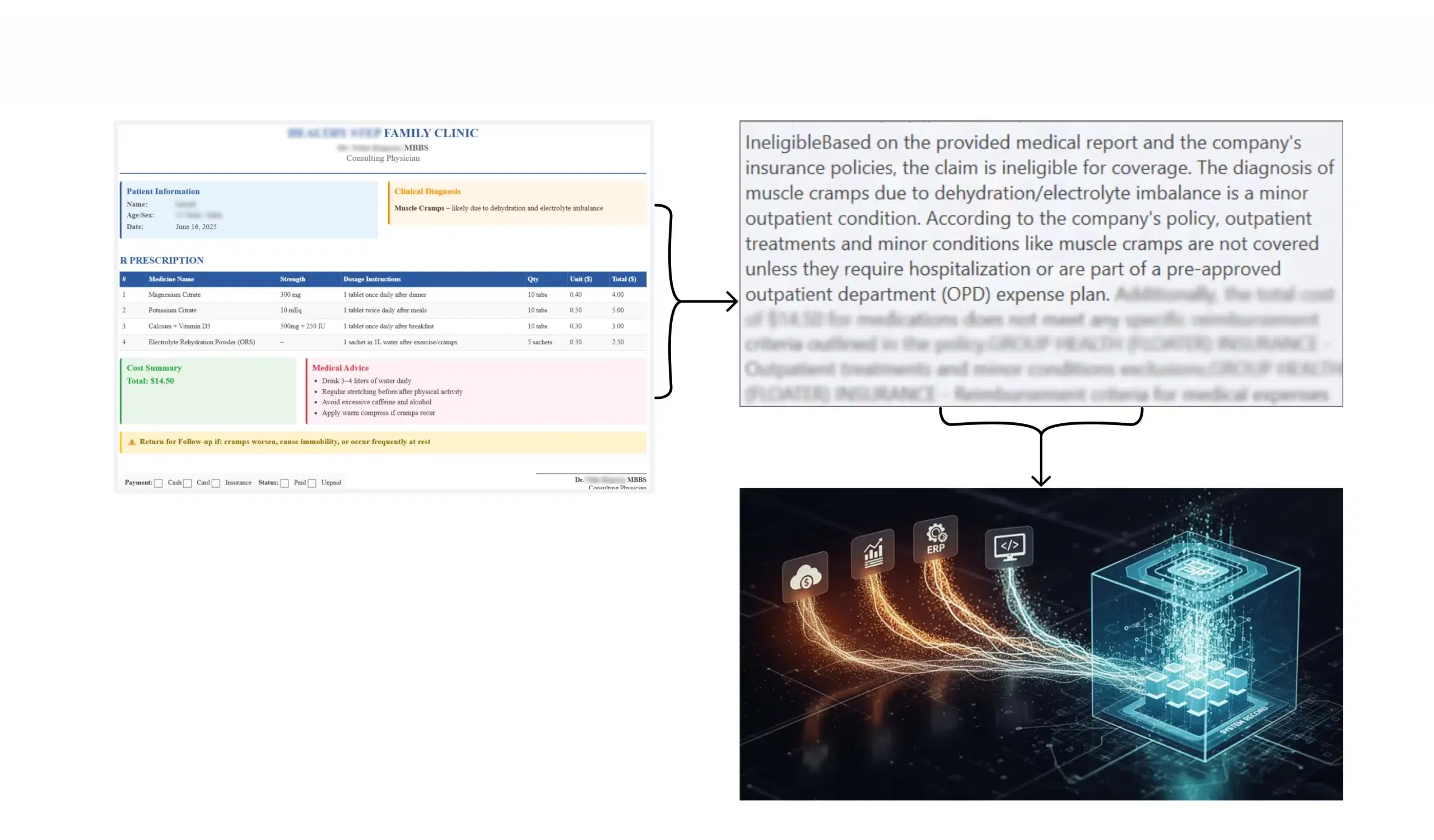
Test Case:
Oracle AI Capabilities for Insurance Claims Automation
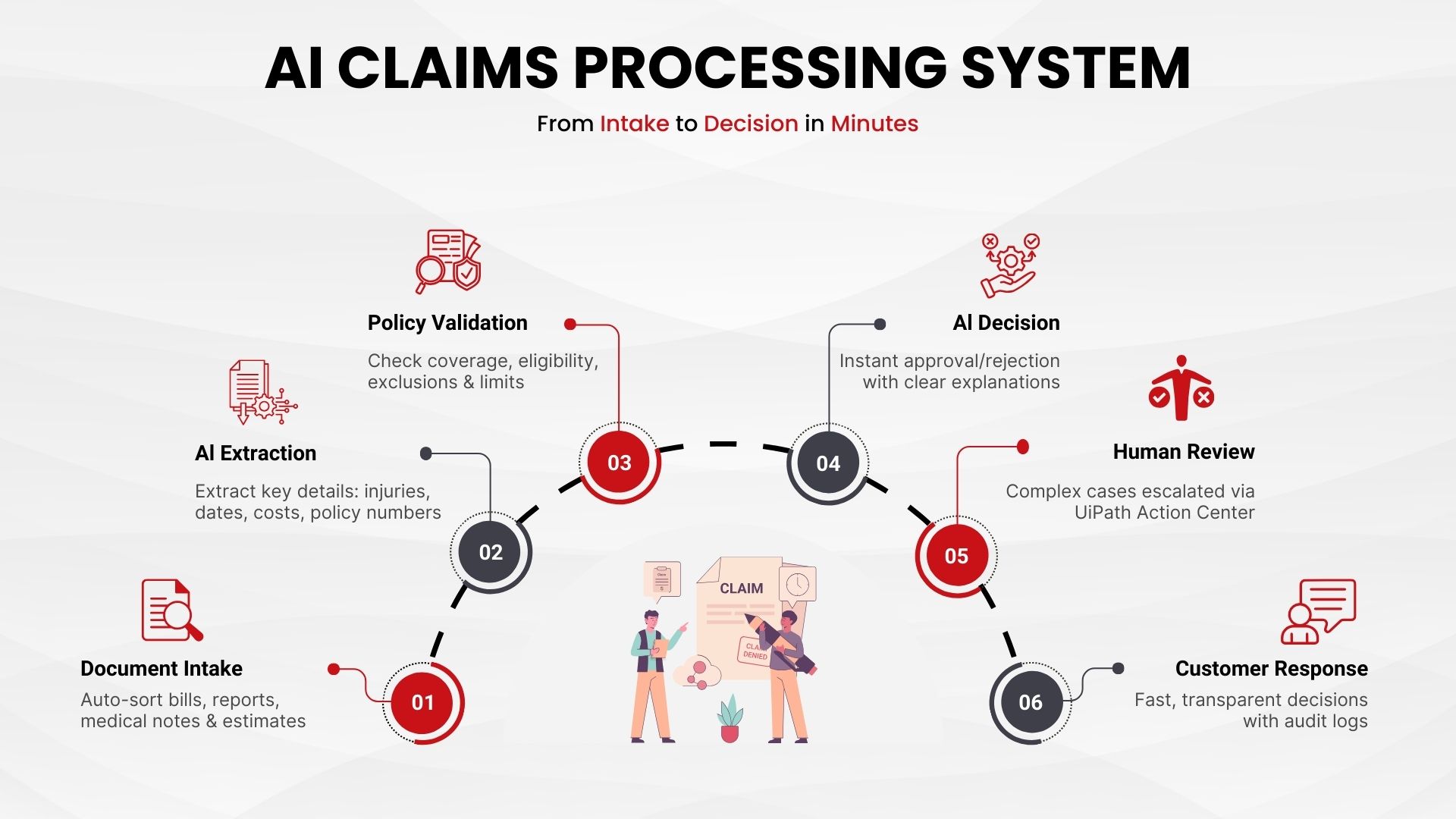
From First Notice of Loss to Settlement: AI at Every Step
Oracle AI for insurance claims automation enterprise covers the complete claims journey:
Step 1 – First Notice of Loss (FNOL) Policyholder submits claim via portal, mobile app, or customer service channel. AI immediately acknowledges receipt, confirms document requirements, and initiates the intake workflow – eliminating the manual triage step that creates the first delay in traditional processing.
Step 2 – Document Collection and Validation AI monitors document completeness in real time, automatically requesting missing items from the policyholder and confirming receipt when submitted. No claim sits idle waiting for a human to notice a missing document.
Step 3 – Eligibility and Coverage Assessment AI verifies policyholder eligibility, active coverage, applicable exclusions, and waiting period status against the submitted claim details – producing a verified eligibility summary within minutes of document completion.
Step 4 – Assessment and Calculation Damage assessment, liability determination, and settlement calculation are performed by AI against policy rules – with every calculation documented and traceable for audit purposes.
Step 5 – Decision and Communication Approved settlements are communicated to the policyholder with a clear breakdown of the decision. Partial approvals include documented rationale for each line item. Escalated cases are transferred to human reviewers with a complete AI-prepared case summary.
Step 6 – Settlement Processing Approved settlements trigger downstream payment workflows automatically – connecting to billing, finance, and payment systems without manual re-entry.
Customer Impact: Faster Resolution, Higher Satisfaction
The measurable impact of reducing claims processing time with AI technology is consistent across enterprise deployments:
- 40–60% reduction in claims processing time – from submission to settlement decision, documented across AI claims automation implementations
- Up to 75% reduction in claim resolution time for standard, well-documented claims processed entirely within AI-defined parameters
- Significantly improved first-contact resolution – policyholders receive accurate status updates and document guidance at every stage rather than waiting for callbacks
- Consistent decision quality – identical claims receive identical treatment regardless of volume, time of day, or adjuster availability
- Fraud detection accuracy – AI models flag anomalies with higher consistency than manual review across high-volume claim environments
- Scalable operations – claim volume surges from seasonal events, weather incidents, or product launches are absorbed without increasing headcount
Today’s policyholders expect more than coverage. They expect speed, transparency, and fairness. AI-powered claims experience for policyholders delivers all three – systematically, at every claim, at scale.
Implementing AI Claims Processing with Rapidflow
Rapidflow designs and implements AI-powered claims workflows tailored to your specific insurance product lines and compliance requirements – across Oracle AI, UiPath, and broader enterprise AI platforms depending on your technology environment.
Our implementation approach covers:
- Insurance claims process audit – mapping current state workflows, handoff points, manual touchpoints, and volume patterns across claim types
- Platform selection and architecture – Oracle AI Agent Studio, Oracle Cloud CX, UiPath Agentic Automation, or hybrid deployment based on your existing stack
- Document intake and classification model configuration across your claim document types
- Policy rules engine setup – eligibility criteria, coverage limits, exclusions, and benefit calculations mapped to AI decision logic
- Fraud detection model calibration against your historical claims data and known fraud patterns
- Escalation workflow design – defining confidence thresholds, edge case routing, and human reviewer handoff protocols
- Integration with policy administration, billing, payment, and customer communication systems
- Compliance and audit trail configuration aligned to your regulatory reporting obligations
- User acceptance testing across all claim types and edge case scenarios
- Claims operations team enablement and AI performance monitoring framework
How does AI improve insurance claims processing?
+
AI automates document intake, damage assessment, fraud detection, and settlement calculation – reducing claim cycle time from days to hours.
What is the typical time saving from AI claims automation?
+
Organizations report 40–60% reduction in claims processing time after implementing AI-powered claims automation systems.
Can Oracle support AI-based claims processing?
+
Yes. Oracle Cloud CX and Oracle AI Agent Studio can be configured to power intelligent claims workflows integrated with policy and billing systems.
Does AI in claims processing improve fraud detection?
+
Significantly. AI models analyze patterns across thousands of claims to flag anomalies and suspicious activity with higher accuracy than manual review.
What types of insurance claims can AI automate?
+
AI can automate motor, property, health, travel, and life insurance claims across first-notice-of-loss, assessment, and settlement stages.
How does Rapidflow help with AI claims automation?
+
Rapidflow designs and implements Oracle AI-powered claims workflows tailored to your specific insurance product lines and compliance requirements.