

Training the Brain: A Practical Guide to Fine-Tuning AI Models for Enterprise Needs
Have you ever thought about building your own large language model for a custom task – something that understands your world perfectly? The idea of creating an AI that speaks your language, follows your workflows, and responds exactly the way your business needs is genuinely exciting.
But then comes reality: building an LLM from scratch is complex, time-consuming, and resource-intensive. For most enterprise teams, that path is neither practical nor necessary.
Fine-tuning AI models enterprise guide starts from a better question: instead of building from zero, what if you could take a powerful, pre-trained model and teach it your domain, your data, and your goals? Fine-tuning makes that possible – and it is the strategic move that transforms general-purpose AI into a domain-aware business intelligence engine.


What Is AI Model Fine-Tuning and Why It Matters
Fine-tuning is the process of taking a pre-trained AI model – GPT, T5, BERT, LLaMA, Cohere – and retraining it on a smaller, task-specific dataset. This helps the model specialize in understanding your specific domain, terminology, data structures, and patterns – producing outputs that are not just syntactically correct, but contextually accurate and business-ready.
Think of it as hiring an exceptionally intelligent new team member. They already know a great deal – language, logic, reasoning, general business concepts – but they still need to learn your company’s vocabulary, your systems, and your specific processes before they can perform at the level you need.
The SQL example that makes fine-tuning concrete:
A general-purpose LLM asked to convert “List the completed orders in the past month” into SQL will return something syntactically plausible:
The structure is correct. The query fails immediately in production – because the model does not know the actual table is called sales_orders, not orders; the status column uses ‘Closed’, not ‘completed’; the date column is created_on, not order_date.
What if you want to fine-tune a really big model like one with billions of parameters but you don’t have a data center? QLoRA is your tool. LoRA as the name suggests, is a Low Rank Adaption technique; it introduces small trainable low-rank matrices while keeping the base model frozen. LoRA is like slipping a few sticky notes into a giant textbook. Instead of rewriting the whole model, you insert small trainable layers LoRA matrices that quietly learn your patterns. When you train LoRA with your examples:
- It learns that “completed” = ‘Closed’
- It understands that “orders” refer to sales_orders
- It memorizes that “past month” = filter using created_on
These small changes plug into the original model and subtly shift how it behaves just enough to get things right for your domain. This approach is limited by memory constraints, as handling a large number of parameters can require substantial GPU resources. To mitigate this, 4-bit or 8-bit quantization can be used.
Adapters are like browser extensions for your AI model. They sit inside the model like tiny assistants, learning only your business logic while the rest of the model stays untouched. In training:
- Adapters learn your internal table names and columns
- They translate “completed” into ‘Closed’ even if the term changes across departments
- They help the model stick to your organization’s terminology
You can even have different adapters for different clients, departments, or schemas and swap them in without retraining the full model. Your base LLM remains powerful and general, but whenever it needs to do your tasks, it plugs in an adapter like switching from “general-purpose” to “expert mode.”
When Should You Fine-Tune vs Use a General Model?
How to fine-tune AI models for specific business needs starts with an honest answer to this question – because fine-tuning is not always the right approach, and deploying it where it is not needed adds cost without benefit.
Use a general model (with prompt engineering and RAG) when:
- Your use case involves general reasoning, summarization, or Q&A across common topics
- Your domain knowledge can be provided at query time through retrieved documents
- Your business rules and vocabulary are relatively standard and well-represented in pre-training data
- Speed to deployment is the priority – prompting and RAG deploy in days; fine-tuning takes weeks
- Your queries vary widely and do not follow consistent patterns
Fine-tune when:
- Your domain has specialized vocabulary the base model consistently misinterprets – medical codes, legal terminology, proprietary schema names
- Output format consistency is required across thousands of responses – specific JSON structures, coding patterns, or report templates
- Prompt engineering consistently fails to meet accuracy targets despite optimization
- Your use case is high-volume and the token cost of elaborate prompts is compounding at scale
- Proprietary business logic must be embedded in the model – and cannot be exposed in every prompt for security reasons
- You require a smaller, faster, cheaper model than frontier LLMs – fine-tuning a smaller base model can match frontier model accuracy on specific tasks at a fraction of the inference cost

The Fine-Tuning Process: Data, Training, and Evaluation
Step-by-step guide to custom LLM fine-tuning enterprise follows a structured workflow from data preparation through production deployment:
- Step 1 – Use Case Definition: Define exactly what the fine-tuned model must do – the specific input format, the expected output format, the accuracy requirements, and the failure modes that matter most. Vague use case definitions produce vague fine-tuned models.
- Step 2 – Training Data Collection and Preparation: Assemble the domain-specific dataset that will teach the model your vocabulary and logic. High-quality training examples – input/output pairs that demonstrate exactly the behavior you want – are more valuable than large volumes of mediocre data. Typically 500-10,000 high-quality examples are sufficient for modern LLM fine-tuning. Data cleaning, formatting consistency, and deduplication are critical – the model learns from what you provide, including your errors.
- Step 3 – Base Model Selection: Choose the pre-trained model you will fine-tune based on your task type, size constraints, and infrastructure. Smaller models (7B parameters) are faster and cheaper to fine-tune and deploy – and for domain-specific tasks, a fine-tuned 7B model frequently outperforms a general-purpose 70B model.
- Step 4 – Fine-Tuning Technique Selection: Choose the appropriate fine-tuning approach based on your compute resources and performance requirements: LoRA (Low-Rank Adaptation) – rather than retraining all model weights, LoRA introduces small trainable low-rank matrices while keeping the base model frozen; QLoRA (Quantized Low-Rank Adaptation) – LoRA combined with 4-bit or 8-bit model quantization, making it possible to fine-tune large models on accessible GPU infrastructure; Full Fine-Tuning – retrains all model weights on your domain data, most accurate but requires substantial GPU compute.
- Step 5 – Training and Monitoring: Run the fine-tuning job – monitoring loss curves, validation accuracy, and overfitting signals throughout. Early stopping prevents the model from overfitting to training examples and losing its general reasoning capability.
- Step 6 – Evaluation: Evaluate the fine-tuned model against a held-out test set of domain examples not used in training. Measure accuracy, output format compliance, and edge case handling. Compare against the base model performance to quantify the fine-tuning improvement.
- Step 7 – Deployment and Monitoring: Deploy the fine-tuned model as an endpoint – on OCI dedicated clusters, self-hosted GPU infrastructure, or fine-tuning API services. Monitor production accuracy, hallucination rate, and output consistency on an ongoing basis. Plan for periodic retraining as domain data evolves.
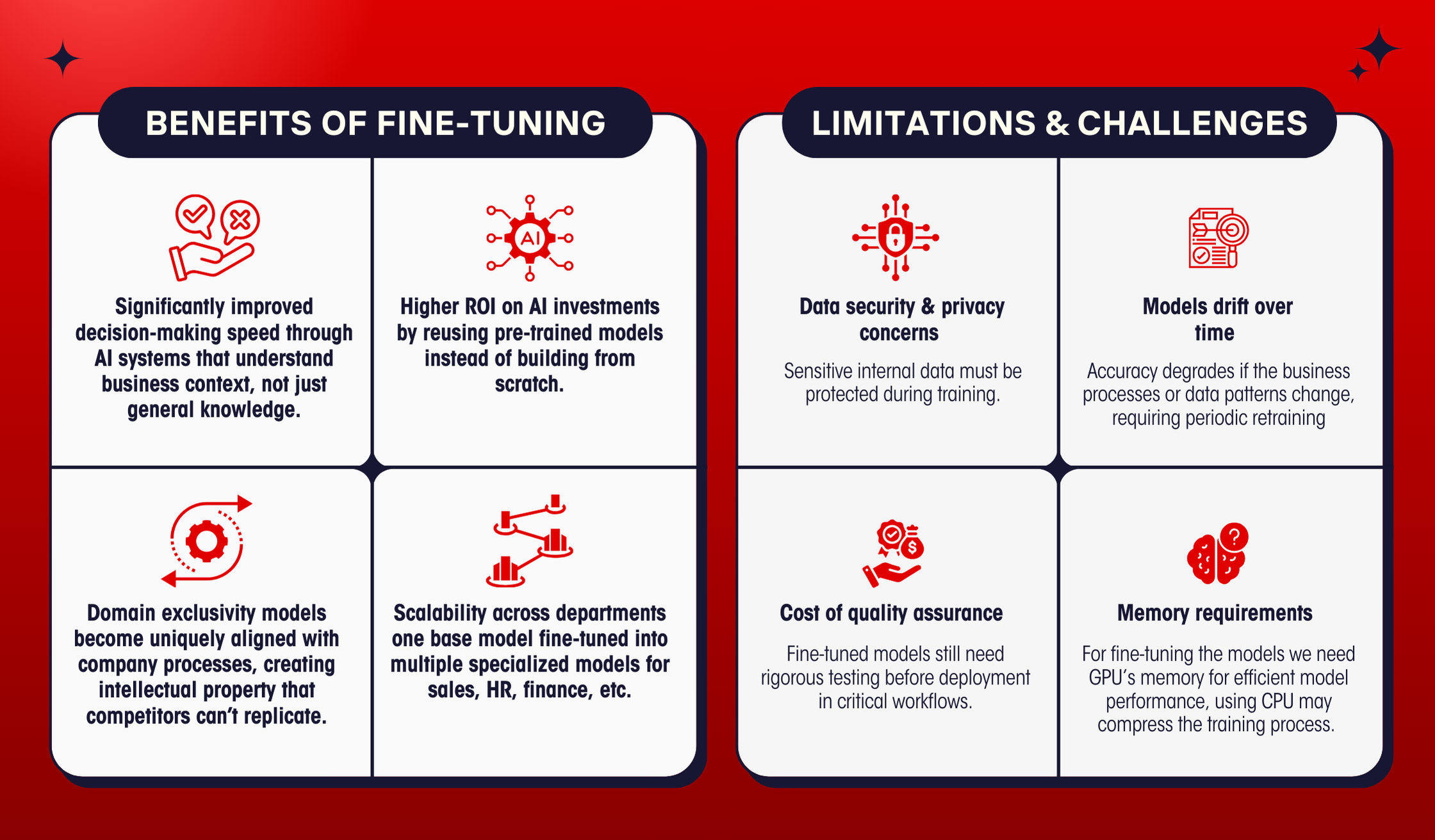
Rapidflow’s Approach to Enterprise AI Model Fine-Tuning
Whether you are building AI Agents using Oracle AI Agent Studio that respond to your specific knowledge base, integrating generative AI into Oracle on-premises applications, deploying an embedded chatbot grounded in your website content, or developing a custom-trained model on your proprietary data – Rapidflow provides end-to-end AI model fine-tuning services across the full development lifecycle.
Our fine-tuning engagement approach covers:
- Use case scoping – defining the specific input/output behavior, accuracy requirements, and failure mode tolerance for your fine-tuning target
- Training data strategy – designing data collection, annotation, cleaning, and formatting workflows aligned to your domain and target model
- Base model selection – evaluating model architecture, size, license, and infrastructure compatibility for your use case
- Fine-tuning technique selection – LoRA, QLoRA, or full fine-tuning recommendation based on your compute resources and accuracy requirements
- Infrastructure configuration – OCI dedicated GPU cluster setup, or evaluation of OpenAI/Cohere fine-tuning API fit for your data sensitivity and volume
- Fine-tuning execution – training job management, monitoring, and early stopping configuration
- Model evaluation – accuracy benchmarking against held-out domain test sets, comparison against base model performance, and edge case analysis
- Production deployment – endpoint configuration on OCI or self-hosted infrastructure, latency optimization, and access control setup
- Monitoring and retraining planning – ongoing production accuracy tracking and retraining schedule aligned to your domain data evolution rate