

The AI Dilemma: Fine-Tuning vs Prompt Engineering in Modern LLMs
The rise of Large Language Models like GPT, LLaMA, and T5 has transformed how enterprises interact with AI
The rise of Large Language Models like GPT, LLaMA, and T5 has transformed how enterprises interact with AI. Whether it is writing content, generating code, answering questions, or translating languages, these models have demonstrated remarkable capability across domains.
But when it comes to adapting LLMs to specialized enterprise tasks, teams consistently face the same decision: should we rely on prompt engineering, or should we invest in fine-tuning the model?
This is the fine-tuning vs prompt engineering LLM dilemma – and the right answer depends entirely on your use case, budget, and performance requirements. Both approaches improve LLM output quality, but they serve different needs and carry different trade-offs.
What Is the Fine-Tuning vs Prompting Dilemma in AI?
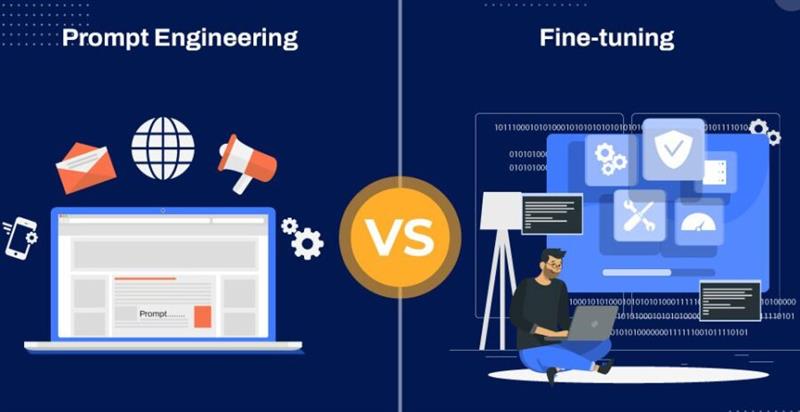
The AI dilemma choosing between fine-tuning and prompting comes down to a fundamental question: do you need to change how the model thinks, or do you need to change how you talk to it?
- Prompt engineering changes how you communicate with an existing model – crafting better inputs to get better outputs, without touching the model itself
- Fine-tuning changes the model itself – training it on domain-specific data so specialized knowledge, vocabulary, and behavior are embedded permanently
Understanding Prompt Engineering: Getting More from Existing Models
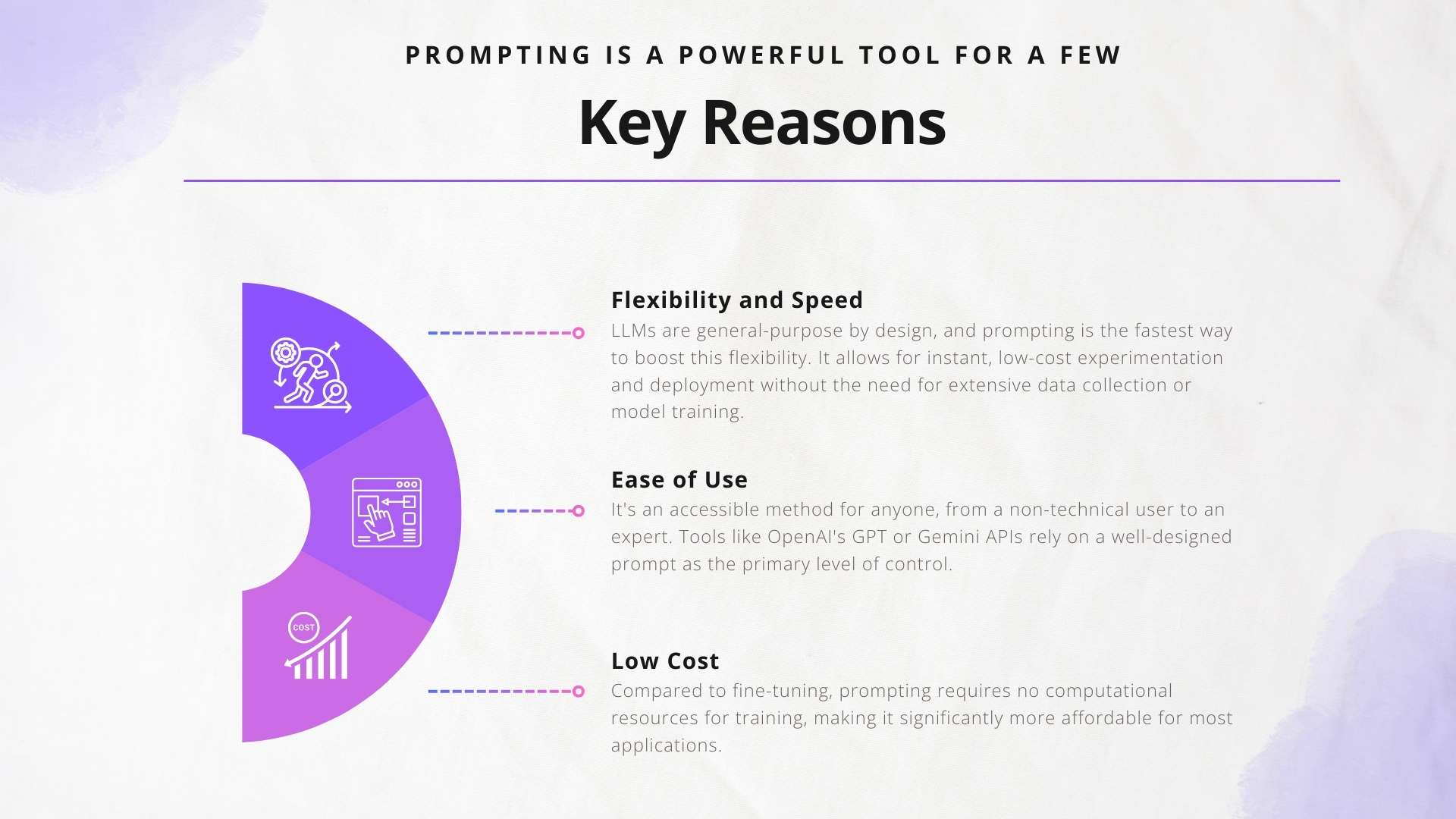
Prompt engineering is the practice of crafting inputs to guide the behavior of an LLM without altering its internal weights. It is about giving smarter instructions to an already-trained model – leveraging the vast knowledge it already contains.
This approach becomes significantly more powerful when combined with Retrieval-Augmented Generation (RAG) – which lets an LLM pull from external sources like internal documents or databases before responding. By grounding answers in real data, RAG improves accuracy, keeps information current, and reduces hallucinations. However, the effectiveness of RAG still depends heavily on prompt quality. Well-engineered prompts lead to smarter, more relevant outputs.
“Generate a poem about nature.” The LLM produces a generic piece using common elements – trees, rivers, sky. Accurate in a broad sense but not aligned to any specific need.
“Act as an expert nature poet inspired by the works of Rabindranath Tagore. Write a four-line poem about the sunrise on a calm lake. The poem should start with the line ‘A golden light first kisses the water.’ Make the poem feel joyful and healing. Focus on the reflection of the light and end by describing the feeling of hope.”
Three Core Prompting Strategies for Enterprise LLMs
Provide the task with no examples; the model relies entirely on pre-trained knowledge. Best for general tasks where the model already has strong baseline capability.
Provide a small number of input-output examples before the actual request, helping the model understand the specific format, style, or pattern required.
Ask the model to reason step-by-step before providing a final answer; particularly effective for complex, multi-part problems like calculations, compliance checks, and logical analysis.
Understanding Fine-Tuning: When and Why to Train Your Model
Fine-tuning is the process of taking a pre-trained LLM and further training it on task-specific data – adjusting its internal parameters to specialize in your domain, task, or style. Think of it like guiding a versatile artist to focus exclusively on creating highly detailed architectural blueprints.
Retrains every parameter in the model on your domain data. Like asking the artist to completely relearn their craft from scratch. Powerful, but expensive, time-consuming, and overkill for most enterprise use cases.
Parameter-Efficient Fine-Tuning — a smarter approach. Give the artist new tools and a specialized sketchbook. They keep their core skills and adapt quickly. LoRA (Low-Rank Adaptation) is the most common PEFT technique – adding small, lightweight layers of domain knowledge without retraining the entire model.
Start with a general LLM for a product support chatbot. Ask it “How do I return this jacket?” and it responds generically: “Check the return policy online.” Ask about a specific product – the “Everest” jacket – and it guesses or invents details it does not actually have.
Fine-tune the model on your product catalog, return policies, support transcripts, and brand guidelines — and the chatbot transforms:
• It knows the exact materials and features of the Everest jacket
• It gives step-by-step return instructions specific to your company
• It speaks in your brand voice — consistently, across every interaction
This is what prompting alone cannot achieve.
Head-to-Head: Fine-Tuning vs Prompting — Cost, Speed, and Accuracy
LLM fine-tuning vs prompt engineering comparison across the dimensions that matter most for enterprise decision-making:
| Dimension | Prompt Engineering | Fine-Tuning |
|---|---|---|
| Cost | Near-zero incremental cost | Significant – GPU compute, data curation, maintenance |
| Speed to deploy | Hours to days | Weeks to months |
| Domain specialization | Limited by pre-trained knowledge | Deep – domain knowledge embedded in model weights |
| Consistency at scale | Variable – prompt-dependent | High – behavior baked into model |
| Flexibility | High – prompts can be updated instantly | Low – retraining required for significant changes |
| Data requirement | None | Substantial labeled dataset required |
| Hallucination risk | Moderate – mitigated by RAG | Lower for in-domain queries |
| Maintenance | Low | High – versioning, retraining, infrastructure |
| Best for | Dynamic, varied, or general tasks | Specialized, high-volume, domain-specific tasks |
Decision Framework: How to Choose the Right LLM Strategy
When should enterprises fine-tune vs prompt LLMs? Use this framework to make the right call:
• The task is general-purpose or varied across use cases
• Speed to deployment is a priority
• Budget is constrained
• The use case changes frequently
• RAG can supplement with domain-specific data at query time
• The use case requires highly specialized vocabulary that the base model does not reliably produce
• Consistent brand voice or output style is required across thousands of outputs
• Prompt engineering consistently fails to meet accuracy targets despite optimization
• The task involves proprietary business logic that should not be exposed in every prompt
• The use case is high-volume and the cost of fine-tuning is offset by prompt token savings at scale
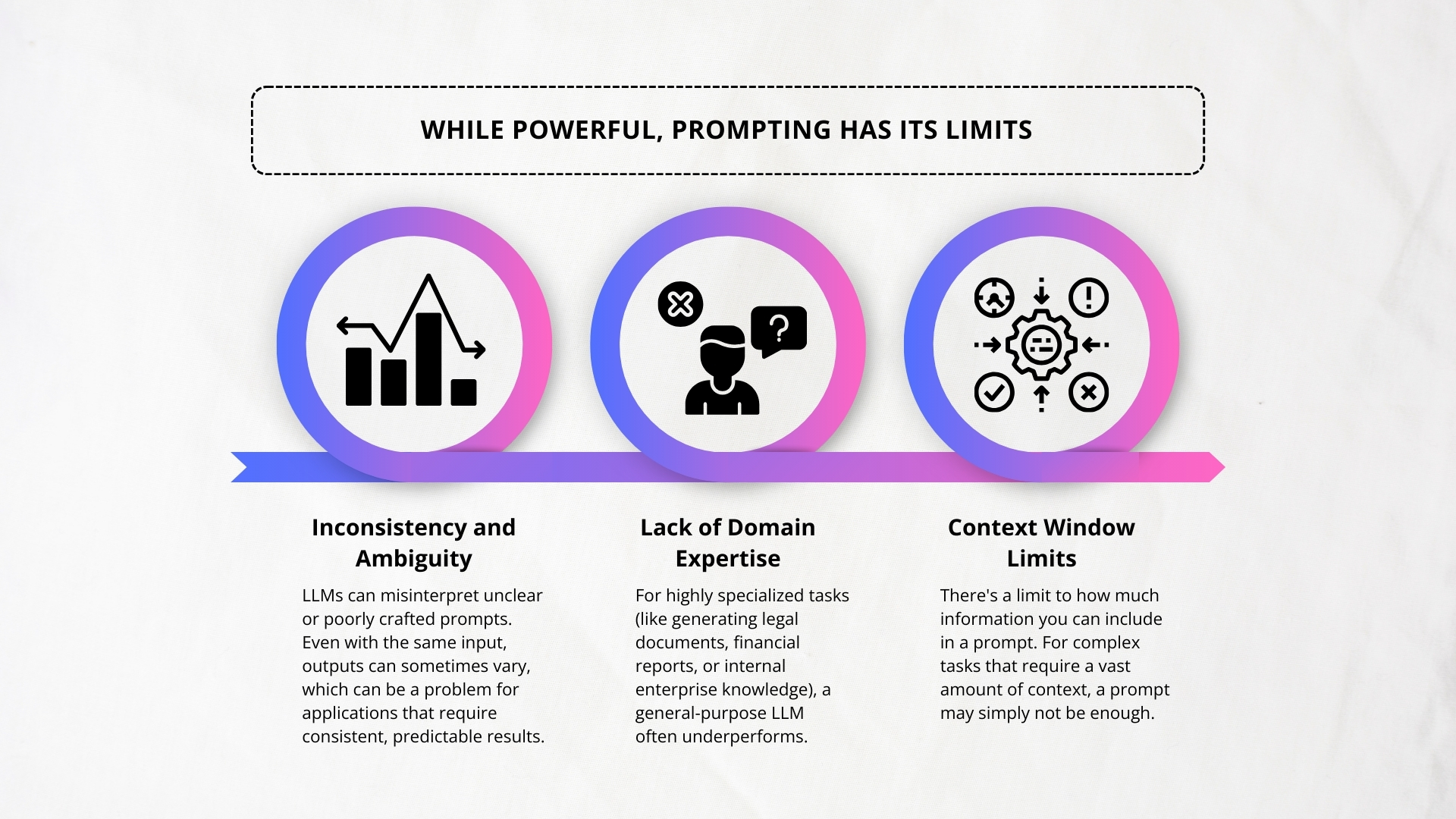
Ignoring prompt engineering: Even a well-trained model produces unpredictable, generic, or vague responses. Without effective prompting, you lose control over output format, tone, and relevance.
Ignoring fine-tuning: The model struggles with domain-specific vocabulary and business logic. Over-reliance on prompting becomes inefficient, and performance drops on structured, high-stakes tasks like SQL generation, compliance checks, or legal summaries.
Ignoring both: The model remains generic — delivering inconsistent results that appear intelligent on the surface but fail under pressure. Unsuitable for real-world enterprise deployment.
Enterprise Recommendations: Fine-Tuning, Prompting, or Both?
The LLM optimization strategy enterprise that delivers the most consistent results is a hybrid approach — and this is what Rapidflow recommends for the majority of enterprise AI programs.
- Fine-tune for permanence — Train the model on the stable, foundational aspects of your domain — product knowledge, policies, brand tone, regulatory vocabulary — so these are reliably embedded in every response.
- Prompt for flexibility — Use few-shot, chain-of-thought, and RAG techniques to handle dynamic, situational needs that change with context, user, or business conditions.
For most Oracle AI deployments specifically, prompt engineering and RAG are the right starting point — due to lower cost, faster deployment, and the strong baseline capability of Oracle-integrated LLMs. Fine-tuning is reserved for specialized, high-volume use cases where prompt engineering has demonstrably hit its ceiling.
Rapidflow conducts AI readiness assessments and recommends the optimal LLM approach — prompting, RAG, fine-tuning, or a hybrid — based on your specific business requirements, existing Oracle environment, and budget. Our LLM strategy advisory covers:
- Current AI use case audit — mapping which tasks are prompt-ready versus fine-tune candidates
- RAG pipeline design and implementation for Oracle-integrated knowledge bases
- Fine-tuning feasibility assessment — data availability, cost-benefit analysis, and timeline estimation
- Prompt engineering optimization for existing Oracle AI Agent Studio deployments
- Hybrid LLM architecture design — combining prompting and fine-tuning within a unified enterprise AI framework
- Ongoing LLM performance monitoring and strategy refinement as model capabilities evolve
Frequently Asked Questions
What is the difference between fine-tuning and prompt engineering in LLMs?
When should you fine-tune an LLM instead of using prompt engineering?
Is prompt engineering cheaper than fine-tuning?
Can prompt engineering match fine-tuning results?
Which approach is better for Oracle AI implementations?
How does Rapidflow advise on LLM strategy?